Best Insulated Soup Carriers: 9 Picks in 2026

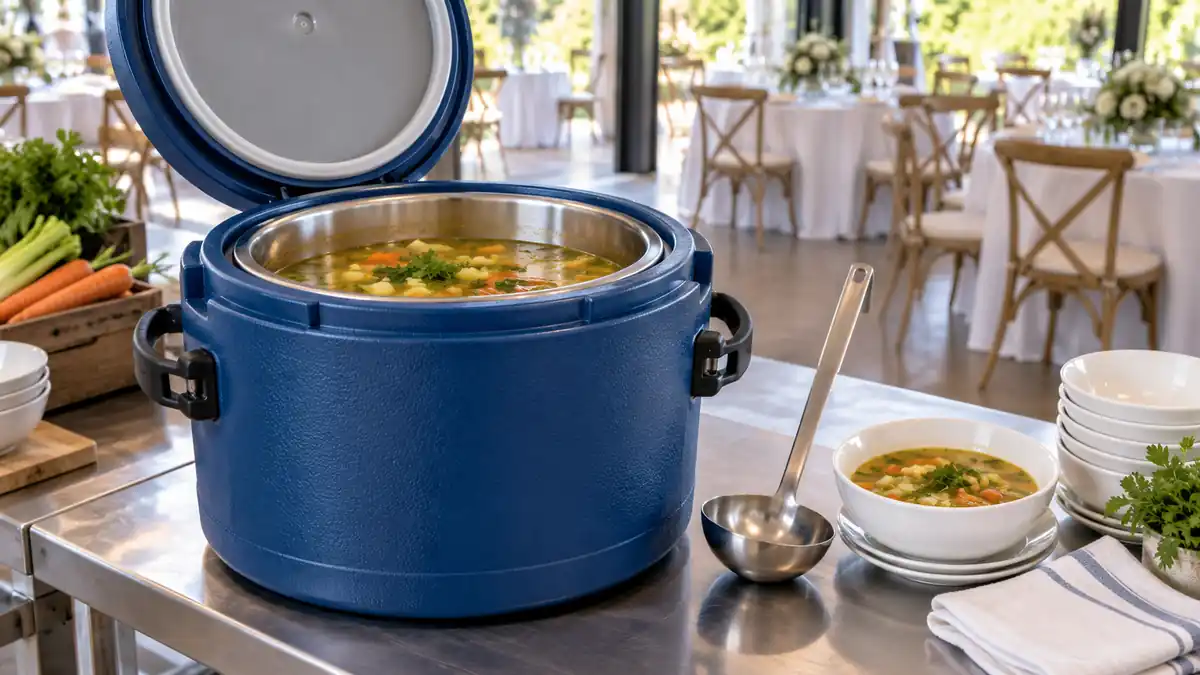
A pot of chili can leave the kitchen piping hot and arrive at a gathering lukewarm, sloshed over the car floor, or packed into several awkward containers. Best insulated soup carriers solve that transport problem through passive insulation rather than active heating. They are built to hold soup, beverages, rice, hot dishes, and similar foods while slowing temperature loss during catering runs, picnics, buffets, family events, and restaurant service.
The common mistake is treating every large thermal bucket as interchangeable. Capacity, lid security, insulation claims, interior material, carrying design, and cleaning access all affect how useful a carrier will be. A 40-liter container can be excellent for a large banquet, yet cumbersome for a small home gathering. A 15-quart carrier may be much easier to lift and store, while a wheeled commercial box can make repeated catering trips less tiring. None of these products actively reheats food, so meals should be brought to the appropriate serving temperature before loading, then monitored according to the applicable food-safety requirements.
The products below focus on genuine insulated soup containers and commercial food carriers. Some emphasize maximum capacity, some offer tighter multi-buckle closures, and others are easier to move through a crowded serving area. The strongest overall match is the Netcoin 40L carrier because its large capacity, stainless steel liner, thick PU foam layer, handles, and non-slip base cover a broad range of transport needs without adding electrical complexity.
Quick Answer
Best Overall: The Netcoin 40L Insulated Soup Carrier offers the most useful blend of capacity, passive insulation, portability, and broad serving applications.
Best for Catering Mobility: The VEVOR 32Qt Insulated Food Carrier adds built-in wheels, stackable top grooves, and a stainless steel inner bucket for repeated commercial transport.
Best for Smaller Loads: The 15-Quart Insulated Soup Pan Carrier takes up less space than the larger commercial barrels while still offering a three-layer construction and a covered storage design.
Best Insulated Soup Carriers Comparison Table
| Product | Best For | Capacity | Insulation and Closure |
|---|---|---|---|
| Netcoin 40L Blue | Large parties and commercial service | 40L / 10.57 gal | 15mm PU foam, lid, dual handles |
| Gtouse 21Qt | Mid-size catering with included spoon | 21Qt / 20L | Foam insulation, two buckles |
| lesolar 32Qt | Large soup service with portion control | 32Qt / 30L | 304 stainless steel, two buckles |
| 15-Quart Soup Pan Carrier | Compact commercial transport | 15Qt / 3.75 gal | Three-layer build, dust cover |
| lesolar 21Qt | Hot and cold food transport | 21Qt / 20L | 304 stainless steel, two buckles |
| VEVOR 32Qt | Catering routes and mobile service | 32Qt | PU foam, snap lock, seal, wheels |
| 15L Portable Carrier | Home events and moderate servings | 15L / 13.62Qt | PU foam, silicone seal, three buckles |
| Jinei 32Qt | Secure large-volume carrying | 32Qt / 8 gal | Silicone seal, four buckles |
| 40L Cold and Hot Carrier | Large parties and beverage service | Listed as 40L / 10.57 gal | 15mm PU foam, silicone seal |
The detailed reviews explain how each carrier differs in size, closure design, movement, and practical serving use.
1. Netcoin 10.57 Gal Insulated Soup Carrier, Blue, Best Overall

Large-volume soup service is where this Netcoin carrier makes the most sense. Its listed 40-liter, or 10.57-gallon, capacity gives caterers, canteens, hotels, and event hosts room for a substantial batch without dividing it among several smaller pots. The stainless steel inner liner is suited to soup, rice, hot dishes, milk, coffee, and cold drinks, while the 15mm PU foam layer separates the interior from the outer shell.
The carrier has side handles and a non-slip bottom, details that matter once a full container is sitting on a prep table or loading surface. The wide opening should also make filling and cleaning less awkward than working through a narrow-neck vessel. The listing describes hot and cold retention for roughly 10 to 15 hours, though actual results depend on the starting temperature, fill level, opening frequency, and surrounding conditions.
Pros
- Large 40L capacity suits high-volume soup and beverage service.
- 15mm PU foam insulation is intended for extended passive temperature retention.
- Stainless steel inner liner supports a range of hot and cold foods.
- Side handles and a non-slip base improve transport stability.
- Wide opening is practical for filling and cleanup.
Cons
- The full 40L capacity can be difficult for one person to lift safely.
- It provides insulation only and does not actively heat or reheat food.
This is the strongest choice for a buffet, community meal, restaurant delivery, or outdoor event that needs one large carrier instead of several small ones. It is less suitable for a compact kitchen with limited storage or for anyone expecting a powered warmer. Preheating the empty container with hot water may help reduce an initial temperature drop, but food still needs proper temperature management before and during service.
To buy this product, click here.
2. Gtouse 21Qt Insulated Soup Container, Best for Mid-Size Catering

A 21-quart carrier sits in a useful middle ground. It has enough room for a substantial pot of soup or a large batch of drinks, yet it is less imposing than the 40-liter models. Gtouse builds this version around a stainless steel inner liner, thick foam insulation, side handles, and a non-slip base. Two stainless steel buckles hold the lid in place, which is especially useful when a container has to cross a parking lot or ride in a catering vehicle.
The included spoon is a small but welcome practical touch for serving lines and event tables. The published information gives retention claims of four to six hours for hot food and six to eight hours for cold food. Those figures describe intended insulation performance rather than a guarantee of safe internal food temperature, so a thermometer and appropriate food-handling procedures remain necessary for commercial service.
Pros
- 21Qt capacity works well for medium-size gatherings and catering jobs.
- Stainless steel liner is suitable for soups, drinks, and other foods.
- Two buckles help secure the lid during transport.
- Included spoon is convenient for serving.
- Handles and a non-slip bottom support routine movement.
Cons
- Its listed retention period is shorter than the claim for the 40L Netcoin carrier.
- It has no powered heating or active temperature control.
Choose this Gtouse model for potlucks, church meals, home catering, and smaller commercial jobs where 40 liters would be excessive. It is easier to fit into a vehicle than a very large barrel, though 21 quarts of liquid can still be heavy. Buyers who need maximum capacity or wheeled movement should look higher in the ranking.
To buy this product, click here.
3. lesolar 32Qt Insulated Soup Container Carrier, Best for Large Serving Batches

The lesolar 32-quart carrier is aimed at the busy serving table where a 20-quart container may run dry too soon. Its 30-liter capacity handles soups, beverages, rice, and hot dishes, while the three-layer construction combines a sturdy outer shell, foam insulation, and a 304 stainless steel inner liner. That arrangement gives it the feel of a commercial transport vessel rather than a soft-sided lunch carrier.
Two stainless steel buckles secure the lid, and the included spoon is handy for direct serving. A detail that deserves attention is the fill guidance. The listing says liquids should remain about 1.97 inches below the opening to help prevent leakage. This is a reminder that usable capacity is not always the same as a sensible transport fill level, especially with thin soup or other liquids that can slosh.
Pros
- 32Qt capacity is suitable for large household or commercial gatherings.
- 304 stainless steel inner liner supports repeated food transport.
- Two buckles improve lid security during movement.
- Included spoon supports buffet and event service.
- Suitable for both hot and cold food transport.
Cons
- Liquids should be filled below the opening to reduce spill risk.
- The container is physically insulated and cannot heat food.
This carrier fits a school event, restaurant side station, banquet, or outdoor meal where a large batch needs to arrive in one container. It may be overkill for a couple of quarts of soup, and its size deserves a clear storage spot before ordering. Follow the fill guidance carefully, since a tightly latched lid does not make an overfilled container spillproof.
To buy this product, click here.
4. 15-Quart Insulated Soup Pan Carrier, Best for Compact Commercial Transport

Not every catering job calls for a 40-liter barrel. This 15-quart carrier is a more manageable option for family dinners, food trucks, snack bars, smaller buffets, and outdoor meals. Its three-layer structure uses a high-strength PE exterior, thick thermal foam, and a stainless steel food-contact lining. The smaller capacity also makes it easier to reserve space for more than one dish during transport.
The listing describes passive retention of hot food for four to six hours and chilled food for six to eight hours. A double-lifting design gives the carrier two ways to move it, while the included dust cover helps keep it protected during storage. The carrier can hold soup, porridge, rice, hot dishes, and certain cold foods, although users should follow the product instructions for each food type and clean the liner promptly after service.
Pros
- 15Qt capacity is easier to manage than larger commercial barrels.
- Three-layer construction includes foam insulation and a stainless steel liner.
- Double-lifting design supports carrying from different positions.
- Dust cover helps protect the carrier during storage.
- Suitable for hot or cold food transport without electrical power.
Cons
- Its smaller capacity may require refills at larger events.
- The published information does not describe adjustable temperature control.
This is a sensible fit for buyers who need a real insulated food carrier but have limited storage or moderate serving quantities. It may be easier to load into a family vehicle than the larger models, though it lacks the wheels found on the VEVOR carrier. Pick it for manageable transport rather than maximum volume.
To buy this product, click here.
5. lesolar 5 Gallon Insulated Soup Container, Best for Hot and Cold Food

This lesolar model targets the familiar 21-quart format, with enough room for a soup course, beverage batch, or side dish without occupying the footprint of a very large carrier. Its 304 stainless steel inner liner sits inside a foam-insulated, three-layer body. That combination is useful for operators who move the same container between a kitchen, serving station, and outdoor table during the day.
The lid uses two stainless steel buckles to improve closure, and the side handles make the container easier to lift from a counter or vehicle. The listing states four to six hours of hot retention and six to eight hours of cold retention. These are passive insulation claims, not active heating specifications. A chilled salad or hot soup should be loaded at the correct starting temperature and checked according to the serving environment.
Pros
- 21Qt capacity suits medium-volume serving.
- 304 stainless steel liner is appropriate for a broad range of foods.
- Two buckles help keep the lid closed during transport.
- Supports both hot and cold food applications.
- Handles make kitchen-to-table movement more practical.
Cons
- There is no electrical heating function.
- Two-buckle closure offers less fastening redundancy than the Jinei model’s four buckles.
This carrier is a good match for caterers and households that switch between hot soup in winter and cold drinks or food in warmer weather. It is easy to understand and does not require outlets, adapters, or fuel. Buyers needing a container for very long service windows should remember that insulation slows temperature change rather than stopping it.
To buy this product, click here.
6. VEVOR 32Qt Insulated Food Carrier, Best for Catering Mobility

The VEVOR carrier stands apart through its transport hardware. Instead of relying only on side handles, it has bottom wheels, built-in grips, and four grooves on top that accept the wheels of another carrier for stacking. That layout makes sense for a catering crew moving food from a prep kitchen to a hall, especially when several containers need to travel together.
Inside, the 32-quart carrier includes a 304 stainless steel bucket with a lid. The LLDPE outer surface and PU foam layer are intended to retain hot food for four to six hours and cold food for three to five hours. A stainless steel snap lock and lid sealing ring help limit leakage and temperature loss. It remains a passive carrier, so the advantage is easier movement and organized stacking rather than active temperature adjustment.
Pros
- Bottom wheels reduce lifting during catering transport.
- 32Qt capacity suits large food batches.
- Stacking grooves help organize multiple carriers.
- 304 stainless steel inner bucket includes a lid.
- Snap lock and sealing ring support a tighter closure.
Cons
- Cold retention is listed at three to five hours, shorter than some bucket-style alternatives.
- Wheels and stacking features add bulk for small household use.
Choose VEVOR when the route from kitchen to serving area matters as much as the insulation. The wheels can be a major relief across a venue floor, while the stacking design may help a commercial team use vertical storage. A homeowner carrying one modest batch may find the larger wheeled body unnecessary.
To buy this product, click here.
7. 15L Portable Commercial Food Warmer, Red, Best for Moderate Servings

With a listed capacity of 15 liters, this red portable carrier is a practical step down from the 20- to 40-liter choices. It can serve a family gathering, picnic, school event, or moderate catering table without asking the user to handle a very large liquid load. The inner stainless steel layer, middle PU foam section, and outer PE layer create a straightforward insulated construction.
The lid uses a silicone sealing ring and three locking buckles. That arrangement is useful for soup because a loose lid can turn a short vehicle trip into a messy cleanup. Side handles support carrying, while the hot-and-cold design gives the container use beyond winter soup service. The supplied information does not give an active heating system or an adjustable temperature range, so treat it as a passive carrier.
Pros
- 15L capacity suits moderate portions and household events.
- Three locking buckles provide multiple points of lid security.
- Silicone sealing ring is intended to reduce leakage.
- Stainless steel, PU foam, and PE form a practical layered build.
- Side handles support outdoor and kitchen-to-table use.
Cons
- It has less capacity than the larger commercial carriers.
- Published information does not specify a retention duration or active heating feature.
This model makes sense for a picnic host who wants more volume than a personal thermos, or a small food seller who does not need a full 32-quart vessel. Its three-buckle lid is appealing for liquid foods, but buyers should still keep the carrier upright and avoid overfilling. It is a compact transport solution, not a reheating appliance.
To buy this product, click here.
8. Jinei 32Qt Commercial Insulated Food Container, Best for Lid Security

Jinei’s 32-quart carrier is built around a four-buckle closure, making it particularly interesting for buyers who worry about a lid shifting during transport. The silicone seal adds another barrier against spills, while the listing describes a vacuum interior and thickened outer construction. Its 32-quart capacity is large enough for catering, buffets, restaurant use, outdoor banquets, and substantial home events.
The container measures 14 by 17 inches according to the supplied product information, though buyers should still confirm available storage space before ordering. Side handles and a wide opening support carrying, filling, and cleaning. The published retention claims are four to six hours for hot food and three to five hours for cold food. As with every passive carrier here, the container does not create heat or verify the internal temperature of its contents.
Pros
- Four stainless steel buckles provide strong lid fastening.
- 32Qt capacity works for catering and buffet service.
- Silicone seal is intended to help reduce leakage.
- Wide opening supports filling and cleaning access.
- Side handles make the carrier portable between service areas.
Cons
- Its cold-retention claim is shorter than several competing carriers.
- The large body may be awkward in small kitchens or crowded vehicles.
Jinei is a fitting choice for soup, gravy, beverages, or other foods where a secure lid matters during movement. Four buckles take a little longer to open than a simple loose cover, yet that tradeoff may be welcome in a catering van. Select it over a smaller carrier when volume and closure security matter more than easy storage.
To buy this product, click here.
9. Cold and Hot 40L Insulated Soup Carrier, Best for Large Beverage Service
This large carrier is listed with a 40-liter, 10.57-gallon capacity, although another specification in the supplied information refers to a 9.25-gallon total capacity. That inconsistency is worth checking before ordering if the exact volume is critical. Either way, the container is intended for substantial batches of soup, drinks, and other foods, with a 15mm PU foam layer between the stainless steel inner liner and plastic outer body.
A silicone sealing ring helps limit spills, and the dual handles make it possible to move the barrel between a kitchen and event table. The wide opening is especially useful for pouring beverages or loading thick soup. The listing describes 10 to 15 hours of hot or cold temperature reserve, but this should be treated as a product claim affected by fill level, ambient temperature, and how often the lid is opened.
Pros
- Very large listed capacity suits parties and commercial service.
- 15mm PU foam layer supports passive hot and cold retention.
- Silicone sealing ring helps reduce leakage during transport.
- Dual handles make the large container easier to move.
- Wide opening is useful for filling and beverage service.
Cons
- The supplied capacity information lists both 40L and 9.25 gallons.
- It does not actively heat or reheat the contents.
This carrier is worth a look for large outdoor meals, beverage stations, and commercial food transport where frequent refilling would be a nuisance. Verify the capacity details and make sure the intended storage area can accommodate a barrel of this size. It is best for buyers who prioritize volume and passive retention over compact handling.
To buy this product, click here.
Buying Guide
Choose Passive Insulation for Transport, Not Reheating
Every product in this roundup is a physically insulated carrier. None lists an electric heating element, thermostat, battery, or fuel system. That distinction matters at a chilly outdoor event: the carrier can slow temperature loss after hot soup is loaded, but it cannot bring refrigerated food up to serving temperature. Heat the food separately, load it promptly, and use a suitable thermometer and food-handling procedure for the application.
The comparison of soup serving equipment and transport carriers helps you plan what happens before loading and after arrival.
Match Capacity to the Actual Batch
The carriers range from about 15 liters to roughly 40 liters. A 15L container is easier to store and carry, while a 32-quart or 40L model reduces the need for refills at a banquet. Large liquid loads become heavy quickly, so capacity should be balanced against the number of people available to lift and pour. Remember that sensible transport fill levels may be lower than the advertised maximum.
Study the Closure Design
Soup is less forgiving than dry food during transport. Two buckles may be adequate for a short, careful trip, while three or four buckles and a silicone seal provide more points of closure. A lid should still be kept level and secured correctly. No listed closure should be treated as a guarantee against leakage when a container is overfilled or tipped.
Prioritize the Right Interior Material
Stainless steel liners appear throughout the selection and are suited to contact with many hot and cold foods. That does not automatically establish dishwasher safety, certification, microwave compatibility, or suitability for every acidic food. Follow the specific care instructions available with the product, and clean food residue soon after service so odors and buildup do not linger.
Plan the Transport Route
Side handles work well for a short move from a kitchen counter to a buffet table. The VEVOR carrier adds wheels and stacking grooves, which may be more useful for a catering crew crossing a venue. A large barrel can still be awkward on stairs, in a narrow vehicle, or beside a crowded prep station. Measure storage and transport space before choosing the largest model.
Interpret Retention Claims Carefully
Published hot and cold retention periods are influenced by starting temperature, quantity, ambient conditions, container material, and lid openings. A carrier’s claimed time is not a measured guarantee for every meal. Preheating an empty carrier with hot water may reduce the shock of loading hot food, but the food itself still needs proper temperature control before and during service.
Best Insulated Soup Carriers FAQ
Do insulated soup carriers actively heat food?
No. The products reviewed here use passive insulation such as PU foam, plastic outer shells, and stainless steel liners. They are intended to slow temperature change after food is loaded. They do not replace an electric soup warmer, stovetop, oven, or other reheating equipment.
Can these carriers hold cold food?
Yes. The listed products are described for both hot and cold food or beverages. Cold retention varies by model, fill level, ambient temperature, and how often the lid is opened. They are useful for transport, but the product information does not establish a guaranteed cold-holding temperature.
Which capacity is practical for a household event?
A 15L carrier is usually easier to store and move for a moderate gathering. The 21-quart models offer more room for soup or drinks without reaching the size of a 32-quart or 40L barrel. Select the smallest capacity that accommodates the batch with reasonable headroom, since a completely full liquid container can be difficult to lift.
Are these suitable for commercial food service?
The listings describe many of them for restaurants, catering, buffets, canteens, and events. Commercial suitability still depends on local rules, operating procedures, cleaning requirements, and any certification required by the facility. None of the supplied product information documents NSF, UL, ETL, or other specific certifications for these exact models.
Can soup be transported right up to the lid?
Leaving some space is prudent because liquid can move during carrying. The lesolar 32-quart listing specifically says to keep liquid about 1.97 inches below the barrel opening. Other models may have different guidance, so follow the supplied instructions and avoid assuming the advertised capacity is the recommended transport fill level.
How should insulated soup carriers be cleaned?
These models have wide openings or stainless steel inner containers that are intended to make filling and cleaning easier. The supplied data does not establish that any complete carrier is dishwasher-safe or that electrical components can be submerged. Clean the food-contact interior according to the product instructions, avoid making unsupported dishwasher assumptions, and dry the carrier fully before storage.
Can an insulated carrier keep food safe all day?
No guarantee should be made from insulation claims alone. The listed retention period is not the same as proof that food remains at a safe internal temperature. For United States household guidance, USDA information generally identifies 140°F or above for hot holding, while commercial requirements may differ under applicable food codes and local rules. Monitor food temperature and follow the requirements for the setting.
Final Verdict
The Netcoin 40L Insulated Soup Carrier is the strongest overall match for Best Insulated Soup Carriers because it combines a large listed capacity with a stainless steel liner, 15mm PU foam insulation, side handles, and a non-slip base. It suits restaurants, outdoor events, buffets, and community meals where a substantial batch needs to move without electrical equipment. Its main tradeoff is physical size and weight once filled.
For repeated catering movement, the VEVOR 32Qt carrier earns attention for its wheels, stacking grooves, snap lock, and stainless steel inner bucket. Buyers with smaller batches may prefer the 15-quart carrier or the 15L portable model, both of which take up less space. The Gtouse and lesolar 21-quart options occupy a useful middle range, while Jinei emphasizes four-buckle closure security. Whichever size you choose, remember that these containers preserve temperature rather than create it, so loading temperature, transport time, cleaning, and food-safety monitoring remain part of the job.

- Graham
Keeping food warm isn't always as simple as it sounds. From family dinners to large catered events, different settings call for different equipment. Graham Ellis approaches these choices with an eye for the details that matter, including temperature control, serving capacity, ease of cleaning, and overall convenience. His contributions to Best Food Warmers aim to make the buying process less confusing and help readers find solutions that fit the way they serve food.
- Best Soup Warmers: 9 Picks in 2027 October 19, 2026
- Best Infrared Food Warmers: 9 Picks in 2026 October 18, 2026
- Heat Lamp vs. Heat Strip: Which Is Better for Food Warming? October 17, 2026
- Best Heat Lamps for Food: 9 Picks in 2026 October 16, 2026
- Best Commercial Heated Holding Carts: 9 Picks in 2026 October 15, 2026