Heat Lamp vs. Heat Strip: Which Is Better for Food Warming?

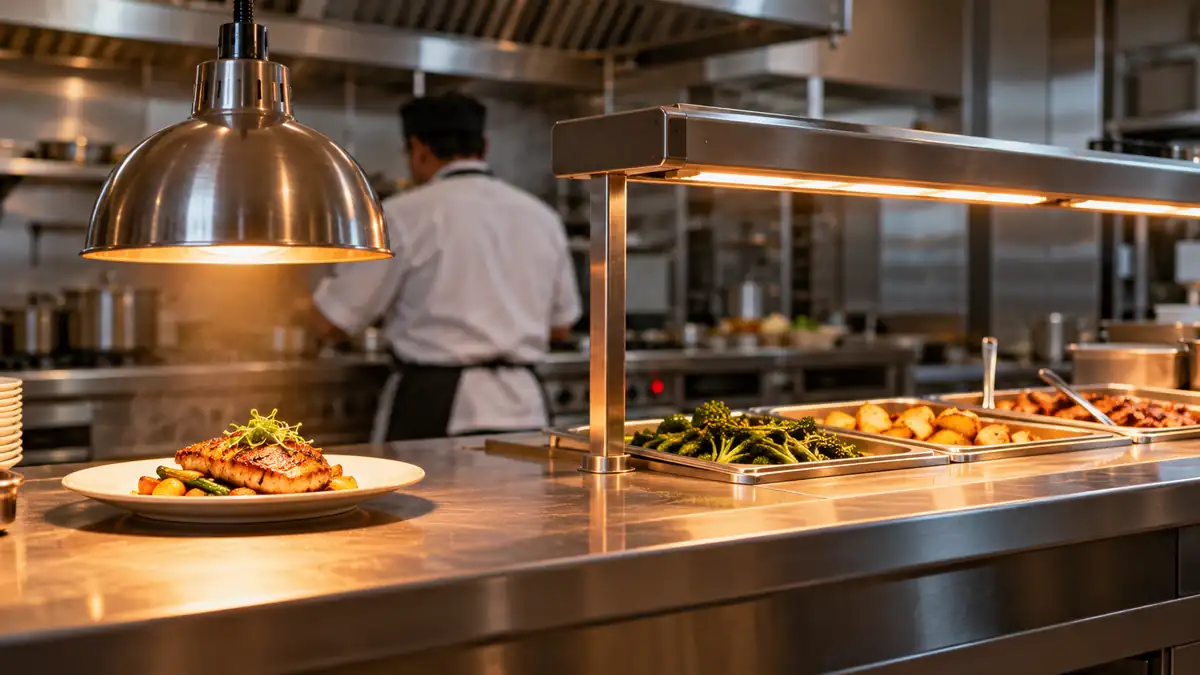
A heat lamp is usually the better fit for a small plating or carving area where heat needs to be directed at a few items. A heat strip is usually better for warming a longer serving line or several plates across a pass. Neither is automatically better at keeping food safe: both primarily heat exposed surfaces, and the food itself must remain at an appropriate hot-holding temperature.
For a small plating area, compare food heat lamps for compact stations by fixture layout, coverage, and installation requirements.
How a Heat Lamp Differs From a Heat Strip
Both types of equipment use radiant heat, which travels from the heating source to surfaces beneath it. A food heat lamp typically uses one or more heat-producing bulbs, often with reflectors that direct warmth toward a limited area. A heat strip, also called a strip heater, generally uses a long heating element mounted above a counter or serving line.
The names can overlap. Some manufacturers sell linear fixtures that use multiple heat lamps, while others combine a strip element with lighting. Check the actual heating element and fixture layout rather than relying on the product name.
| Consideration | Heat lamp | Heat strip |
|---|---|---|
| Typical coverage | Concentrated beneath a bulb or group of bulbs | Extended along the length of the element |
| Common placement | Over a plating station, carving area, or small display | Over a service pass or row of serving pans |
| Installation | May be a portable or mounted fixture, depending on the model | Usually mounted above a defined work area |
| Coverage limits | Areas outside the beam receive less direct heat | Food beyond the strip’s length or away from its heating zone receives less direct heat |
Actual coverage depends on the fixture, reflector or element design, mounting position, and arrangement of the food. A strip is not guaranteed to heat evenly from end to end, and a lamp with multiple bulbs may cover more than one plate.
Which Works Better for Your Setup?
For Plated Food and Small Work Areas
A heat lamp makes sense over a compact pickup station where finished plates wait briefly for service. Its directed heat can be useful when the area to cover is clearly defined. The limitation is coverage: a plate moved away from the heated zone may receive substantially less warmth. Bulb-based fixtures also require the correct replacement bulb for the fixture.
For a Service Pass or Buffet Line
A heat strip is often a more practical shape for a long counter with plates or shallow serving pans arranged in a row. The continuous fixture can cover a broader span without positioning a separate lamp over each spot. Its length still needs to match the area in use, and containers must sit within the heating zone specified for the equipment.
For deep pans, soups, or dense foods, overhead radiant heat may warm the surface while the food below cools. A suitable heated well, steam table, or other hot-holding equipment may be needed to maintain temperature throughout the food. Overhead heat can complement such equipment, but it should not be assumed to replace it.
For a longer counter, our guide to infrared warmers for a service pass includes the fixture formats to compare.
Food Temperature Matters More Than Fixture Type
Heat lamps and strips are intended to help hold food that has already been cooked or properly reheated. They are not substitutes for cooking, and an overhead warmer should not be used to slowly reheat refrigerated leftovers unless the equipment is specifically intended for that task and the applicable reheating requirements can be met.
For household use in the United States, USDA guidance generally recommends keeping hot food at 140°F (60°C) or above. For commercial food service, the FDA Food Code generally specifies hot holding at 135°F (57°C) or above for food requiring time and temperature control for safety, subject to its provisions and exceptions. The Food Code is a model code; a food business must follow the rules applicable to its location and operation.
A glowing bulb, hot element, or warm food surface does not establish the temperature inside a pan of food. Use a suitable food thermometer to check the food, including areas that receive less direct heat and the interior of deeper portions. If the setup cannot maintain the required temperature, adjust the holding method rather than assuming a different overhead fixture will solve the problem.
Quality matters as well. Prolonged direct heat can dry exposed food or make its surface unappealing before service. Covers or pans can help with some foods, but they can also affect how radiant heat reaches the contents. Assess both food temperature and serving quality in the actual configuration.
Use our guide to setting a food warmer and checking the food when translating an equipment setting into a service routine.
Installation and Operating Considerations
Mounting height, clearances, and compatible accessories are specific to each fixture. Follow the manufacturer’s instructions for distance from food, surrounding surfaces, and combustible materials. Do not lower a fixture or substitute a higher-rated bulb to try to compensate for inadequate holding performance.
- Match the heated area to the food layout. Check where plates and pans will sit during busy service, including positions at the ends of a pass.
- Check electrical requirements. Use a compatible power supply and follow the installation instructions. Fixed commercial installations may require a qualified installer.
- Allow for safe handling. Fixtures and nearby surfaces can become hot. Keep cords and serving activity clear of hot components, and let the equipment cool before cleaning or replacing a bulb.
- Follow food-service requirements. In a commercial setting, check applicable rules for equipment placement and bulb protection where food is exposed.
A heat lamp suits a focused station; a heat strip suits a longer, defined serving area. Choose based on the space the fixture must cover, then verify that the complete holding setup keeps the food at the required temperature.

- Graham
Keeping food warm isn't always as simple as it sounds. From family dinners to large catered events, different settings call for different equipment. Graham Ellis approaches these choices with an eye for the details that matter, including temperature control, serving capacity, ease of cleaning, and overall convenience. His contributions to Best Food Warmers aim to make the buying process less confusing and help readers find solutions that fit the way they serve food.
- Best Soup Warmers: 9 Picks in 2027 October 19, 2026
- Best Infrared Food Warmers: 9 Picks in 2026 October 18, 2026
- Heat Lamp vs. Heat Strip: Which Is Better for Food Warming? October 17, 2026
- Best Heat Lamps for Food: 9 Picks in 2026 October 16, 2026
- Best Commercial Heated Holding Carts: 9 Picks in 2026 October 15, 2026