Buffet Server vs. Chafing Dish: Which One Do You Need?

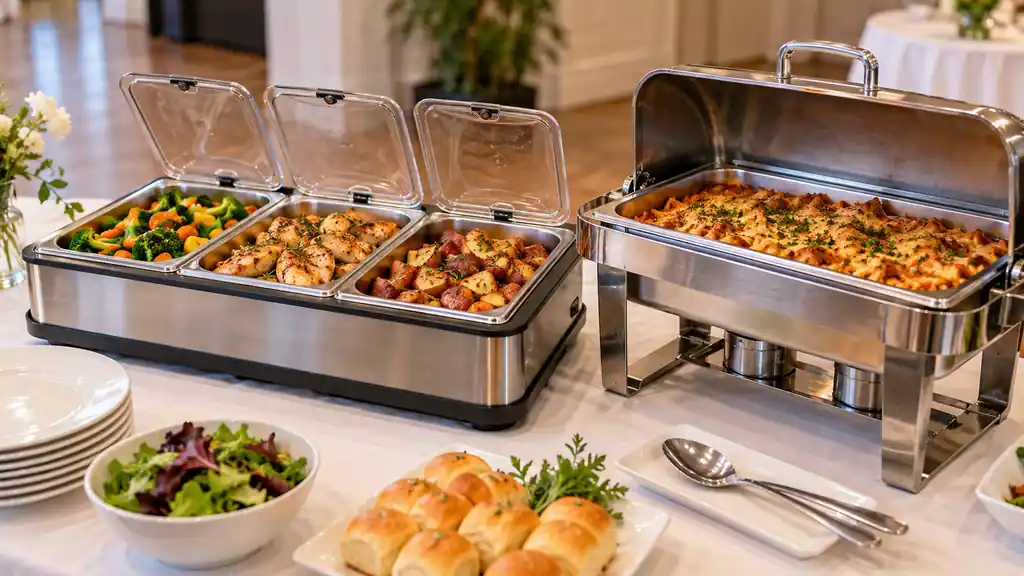
A buffet server is usually the simpler choice for serving several hot dishes near an electrical outlet. It typically pairs a heated base with removable, lidded food pans. A chafing dish is often better for a larger serving pan or a setup away from an outlet, provided its fuel or electric heat source is permitted at the venue. Both are primarily for holding food that is already hot, not for cooking or slowly reheating cold food.
If you want several foods arranged on one powered base, compare buffet servers for several dishes before deciding how to lay out the table.
How the Two Setups Differ
The names describe common configurations, not rigid equipment standards. Check the construction of the specific unit, especially how it heats the food and which pans it accepts.
| Feature | Buffet Server | Chafing Dish |
|---|---|---|
| Typical layout | A heating base with multiple removable food pans and lids | A frame supporting a food pan, often above a water pan, with a lid |
| Heat source | Usually electric | Often chafing fuel; electric versions are also available |
| Serving arrangement | Separate compartments make it easy to offer several dishes | Often uses one larger pan, though divided pans and inserts may be available |
| Setup needs | A suitable outlet and space for the base and cord | A suitable heat source; water-bath models also need water and monitoring |
A typical fuel-heated chafing dish warms its water pan, which transfers heat to the food pan above it. That arrangement helps moderate the heat reaching the food. Many buffet servers heat their pans from a base without a separate water bath, but designs vary. Neither name alone tells you exactly how the equipment operates.
Which Setup Fits Your Meal?
Choose a Buffet Server for Several Dishes in One Place
A buffet server suits a counter or serving table where an outlet is available and you want distinct portions of food, such as a main dish and two sides. Its included pans establish the serving layout, so check whether their individual capacity and shape fit the dishes you plan to serve. Three compartments can be convenient, but they may be less useful if one dish needs most of the available space.
Plan the cord route before setting out the food. Keep it away from walkways, liquids, and places where guests could pull it. Follow the unit’s instructions for compatible pans, countertop placement, and electrical use. Do not assume pans from another server will fit or heat properly.
Choose a Chafing Dish for Flexible Placement or a Larger Pan
A fuel-heated chafing dish can serve food where a suitable outlet is unavailable. It also works well when you need a broad pan for one dish or want to arrange multiple matching stations. Its portability has conditions: you need a stable, heat-safe location, an approved heat source, and permission to use it at the venue.
For a water-bath model, follow the manufacturer’s water instructions and check the pan during service. Too little water can interfere with operation, while too much can spill when the food pan is installed. Fuel containers require careful handling around guests, linens, and other combustible materials. Use only fuel approved for the equipment, follow the fuel and dish instructions, and never add fuel to a burning or hot container. An electric chafing dish avoids an exposed fuel flame but requires an appropriate power source.
For a larger pan or a more flexible layout, our comparison of chafing dishes for flexible buffet layouts covers the main formats.
What Matters Beyond the Equipment Label
Before deciding, match the setup to the food and the serving space:
- Menu and portions: Several modest dishes favor separate buffet-server pans. A large quantity of one dish may fit a chafing dish more naturally. Check actual pan capacity rather than relying on the number of compartments.
- Venue rules: Confirm that the available electrical supply suits the appliance or that the venue permits the proposed fuel source. Indoor fuel use may be subject to venue fire-safety requirements.
- Attention during service: A water-bath chafer needs water checks, and fuel must be handled according to its instructions. An electric server needs a secure cord and a suitable outlet. Both need food-temperature checks.
- Cleanup: Removable food pans may be easier to wash separately, but dishwasher compatibility depends on the model. Allow equipment to cool, disconnect electric units, and keep electrical assemblies out of water unless their instructions explicitly permit otherwise.
Neither option is automatically more portable, easier to clean, or better at maintaining temperature in every setting. A compact electric chafer may behave more like a buffet server in daily use, while a large buffet server may take up more table space than expected.
Review the steps for setting up a chafing dish before committing to a fuel or water-bath arrangement.
Hot Holding Is Different From Reheating
Place food in either setup after it has been cooked or reheated appropriately. Do not rely on a chafing dish or buffet server to bring refrigerated food up to a safe serving temperature unless the exact equipment is intended for that task and the applicable food safety requirements can be met. For household leftovers, USDA guidance generally recommends reheating to an internal temperature of 165°F (74°C).
For household service in the United States, USDA guidance generally recommends keeping hot food at 140°F (60°C) or above. In commercial food service, the FDA Food Code generally specifies hot holding food requiring time and temperature control for safety at 135°F (57°C) or above, subject to its provisions and exceptions. The Food Code is a model code; a commercial operation must follow its applicable state and local requirements.
Measure the food with a suitable food thermometer, particularly after loading the pans and during extended service. A buffet server’s control setting, a chafer’s water temperature, or the presence of a flame does not establish the temperature inside the food. Food depth, initial temperature, lid use, and equipment performance all affect the result. Neither type guarantees a safe holding duration without effective temperature control.
The Practical Choice
Use a buffet server when you want several defined serving compartments and have a suitable outlet. Use a chafing dish when a larger pan or fuel-heated placement better suits the event, and you can meet its water, fuel, and venue requirements. Whichever arrangement you choose, start with properly heated food and verify that the food itself stays at an appropriate holding temperature.
For a mixed menu, planning a party buffet helps you assign each dish to an appropriate holding method.

- Graham
Keeping food warm isn't always as simple as it sounds. From family dinners to large catered events, different settings call for different equipment. Graham Ellis approaches these choices with an eye for the details that matter, including temperature control, serving capacity, ease of cleaning, and overall convenience. His contributions to Best Food Warmers aim to make the buying process less confusing and help readers find solutions that fit the way they serve food.
- Best Soup Warmers: 9 Picks in 2027 October 19, 2026
- Best Infrared Food Warmers: 9 Picks in 2026 October 18, 2026
- Heat Lamp vs. Heat Strip: Which Is Better for Food Warming? October 17, 2026
- Best Heat Lamps for Food: 9 Picks in 2026 October 16, 2026
- Best Commercial Heated Holding Carts: 9 Picks in 2026 October 15, 2026