How Long Does Food Stay Hot in a Thermos?

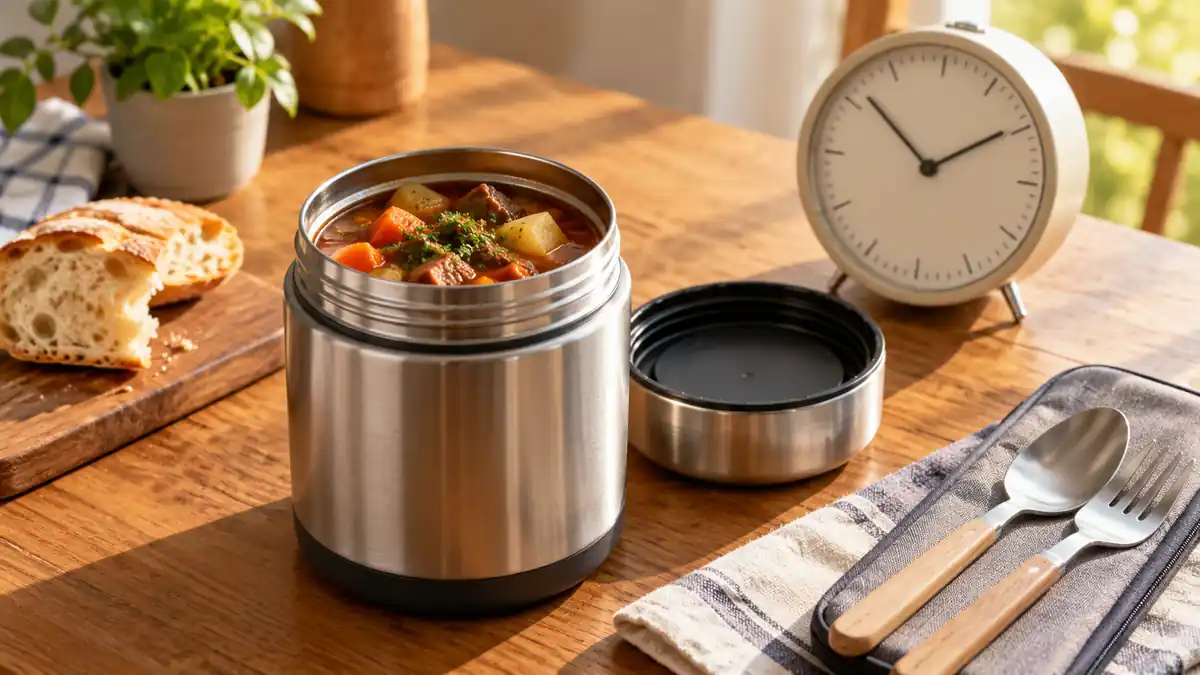
Food can stay pleasantly hot in an insulated food thermos for several hours, but there is no reliable number of hours that applies to every jar or meal. A full, preheated vacuum-insulated jar packed with very hot soup will generally retain heat longer than a partly filled jar of lukewarm food. More importantly, food that still feels warm may have cooled below a safe hot-holding temperature.
If you are choosing a container for a packed meal, compare food thermoses by capacity and lid design rather than selecting by a claimed number of hours alone.
Why the Time Varies
A food thermos uses insulation to slow heat loss. It does not add heat, so the food begins cooling as soon as it is packed. How quickly it cools depends on several factors:
- Starting temperature: Food packed piping hot has more heat to lose than food packed after it has cooled on the counter.
- Jar construction: Vacuum insulation, lid design, and the width of the opening affect heat retention. A manufacturer’s retention claim may be based on controlled conditions rather than your packed lunch.
- Fill level and food quantity: A larger amount of hot food generally cools more slowly than a small portion in the same jar.
- Preheating: Warming the jar as directed by its manufacturer reduces the heat the container draws from the food when it is filled.
- Surroundings and use: A cold environment and repeated lid openings can shorten the time food stays hot.
Texture matters too. A jar filled with hot soup has fewer air gaps than one loosely packed with solid pieces. Neither food type has a guaranteed safe holding time simply because it is in a thermos.
For meals built around soup or stew, our comparison of soup thermoses for packed lunches focuses on food-jar sizes and serving access.
Hot Enough to Eat Is Different From Safe to Hold
For household use, USDA guidance recommends keeping hot perishable food at 140°F (60°C) or above. A thermos has no thermostat or heating element to maintain that temperature. Its exterior may feel warm while the food inside is cooler, and food may feel warm to your mouth after it has dropped below 140°F.
For a packed lunch containing perishable food, the best way to check performance is with a food thermometer. Measure the food shortly before closing the jar and again when you would normally eat it. This can show how that particular jar and meal perform under those conditions. It does not establish a guaranteed safe duration for every future use.
If perishable food is below 140°F when you open the jar, you cannot tell from that reading alone how long it has been below that temperature. USDA household guidance limits perishable food in the 40°F to 140°F danger zone to two hours. If you cannot establish that the food remained hot enough or that it spent less than two hours below 140°F, the safer choice is to discard it. Do not use taste or smell to judge its safety.
Commercial food service follows applicable state and local rules. The FDA Food Code generally specifies hot holding at 135°F (57°C) or above for foods requiring time and temperature control for safety, subject to its provisions and exceptions. That commercial standard should not be treated as a guarantee that an unmonitored, passively insulated jar will keep food safe.
What a Manufacturer’s Heat-Retention Rating Tells You
A label stating that a jar keeps food hot for a specified number of hours describes its claimed insulation performance under particular conditions. It does not necessarily mean the food remains above 140°F for that entire period. The test may start with hotter contents, a fuller container, or a different surrounding temperature than your lunch.
Use a rating as a comparison point, not as a food safety timer. For a routine such as packing lunch in the morning and eating it in the afternoon, temperature checks with your usual food, fill level, and schedule provide more relevant information.
Give a Thermos the Best Chance to Retain Heat
Preheat the jar according to its instructions, then empty it before adding food. Pack food that has been properly cooked or reheated, fill the jar promptly, and close the lid securely. For household leftovers, USDA guidance recommends reheating to an internal temperature of 165°F (74°C) before packing. The thermos itself is for insulation, not reheating refrigerated food.
Keep the lid closed until mealtime. These steps reduce heat loss, but they cannot guarantee that perishable food will remain at a safe hot-holding temperature for a fixed number of hours.
A thermos can make a hot meal practical hours after packing. The useful limit, however, is determined by the food’s actual temperature, not the clock, the jar’s label, or how warm the outside feels.
Follow our steps for preheating and packing a food thermos to reduce avoidable heat loss before you leave.

- Graham
Keeping food warm isn't always as simple as it sounds. From family dinners to large catered events, different settings call for different equipment. Graham Ellis approaches these choices with an eye for the details that matter, including temperature control, serving capacity, ease of cleaning, and overall convenience. His contributions to Best Food Warmers aim to make the buying process less confusing and help readers find solutions that fit the way they serve food.
- Best Soup Warmers: 9 Picks in 2027 October 19, 2026
- Best Infrared Food Warmers: 9 Picks in 2026 October 18, 2026
- Heat Lamp vs. Heat Strip: Which Is Better for Food Warming? October 17, 2026
- Best Heat Lamps for Food: 9 Picks in 2026 October 16, 2026
- Best Commercial Heated Holding Carts: 9 Picks in 2026 October 15, 2026