Best Warming Trays: 9 Picks in 2026

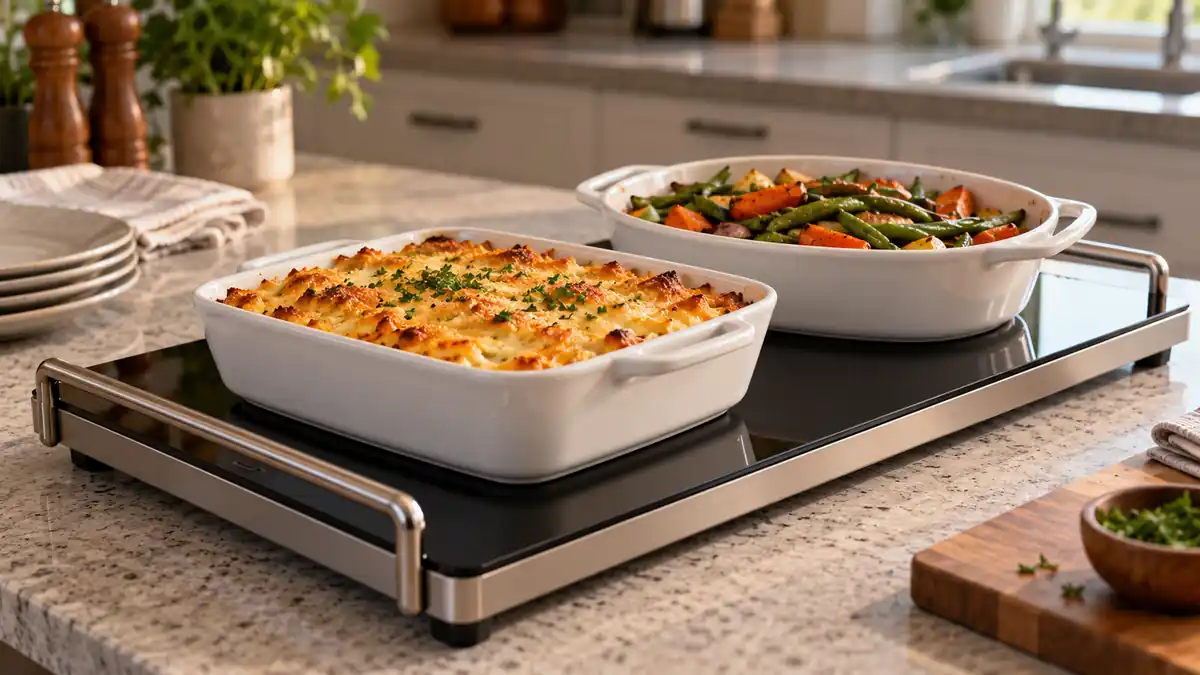
A crowded holiday table can turn into a slow shuffle of casserole dishes, foil pans, and plates that cool before everyone gets seconds. The best warming trays help by giving already-hot food a heated surface while guests serve themselves, making them useful for family dinners, potlucks, buffet lines, and small catering setups. The key decision is whether you need a rigid glass tray, a flexible rollable mat, or a modular system that changes size with the occasion.
Warming trays are often confused with appliances that cook or reheat food. Most products in this comparison are intended for surface warming and holding, so the food should generally be hot before it goes onto the tray. Size matters too. A 21-inch surface may suit a dining table, while a 47-inch modular layout needs a long island, banquet table, or catering setup. Temperature range, timer controls, container compatibility, countertop protection, storage, and the product’s electrical requirements all deserve attention.
The nine options below include rigid tempered-glass trays, flexible silicone mats, and expandable panel systems. Priorities vary widely: a frequent host may prefer modular capacity, a small household may value compact storage, and a caterer may need a long continuous surface. The comparison starts with a quick answer, then moves through the specifications and trade-offs that separate these warming trays in everyday use.
Quick Answer
- Best Overall: FEPPO Electric Warming Tray combines a 33-by-15-inch surface, modular panels, 10 temperature settings, a timer, and child-lock protection.
- Best for Large Gatherings: FEPPO 47-Inch Electric Food Warming Tray creates the longest serving layout in the group and offers separate controls by connected panel.
- Best Flexible Storage: LBOLHZO Warming Mat rolls down to a smaller footprint and provides a 36-by-16-inch silicone warming surface.
- Best Compact Option: LNNIW Warming Mat uses a 26-by-15-inch layout, a detachable heat-resistant pad, six settings, and a one-to-six-hour timer.
Best Warming Trays Comparison Table
| Product | Best For | Heating Surface | Temperature Control | Power |
|---|---|---|---|---|
| FEPPO Electric Warming Tray | Flexible buffet setups | 33 × 15 in., tempered glass, modular | 10 settings, timer | Electric, specification not listed |
| Wanish Electric Warming Tray | Everyday buffet serving | 32 × 12 in., tempered glass | Two modes, thermostat | Electric, 78-inch cord |
| FEPPO 47-Inch Electric Food Warming Tray | Large gatherings and catering | 47 × 15 in., modular glass | 10 settings, 30-minute to 6-hour timer | Electric, main panel connection |
| Chefman Electric Warming Tray | Countertop family meals | 21 × 16 in., tempered glass | Adjustable control, dual thermostats | 450 watts, 120 volts |
| LBOLHZO Warming Mat | Large flexible layouts | 36 × 16 in., silicone, rollable | 6 settings, auto shutoff | 580 watts, 110 volts |
| LNNIW Warming Mat | Compact family meals | 26 × 15 in., warming mat with pad | 6 settings, 1-to-6-hour timer | Electric, specification not listed |
| 4-in-1 Detachable Electric Warming Tray | Expandable home buffets | Up to 33 × 15 in., modular glass | 9 settings, 24-hour timer | Electric, specification not listed |
| Silicone Warming Mat | Portable storage and large coverage | 32 × 15 in., rollable silicone | 7 settings, 1-to-8-hour timer | Electric, specification not listed |
| BTUVC Electric Warming Tray | Modular entertaining | 35 × 15 in., tempered glass | 8 settings, 24-hour timer | Electric, specification not listed |
The detailed reviews below look at how each tray handles surface area, controls, storage, cookware compatibility, and the practical limits that matter once food is arranged for serving.
1. FEPPO Electric Warming Tray — Best Overall

A dinner party rarely stays the same size from one occasion to the next. One night may call for a single casserole, while a holiday buffet needs room for several serving dishes. FEPPO addresses that change with detachable panels that can be arranged from one to four sections. Its full 33-by-15-inch tempered-glass surface is listed as suitable for roughly six to eight dishes, though the actual count depends on plate and pan dimensions.
The control package is unusually adaptable for a home warming tray. Ten temperature settings span 86°F to 248°F, and the built-in timer gives more control than a simple low-high switch. The listing also describes overheat protection and a child lock, useful details in a busy kitchen where hands, cords, and curious children may all be competing for attention. This is a surface warmer, so it should not be treated as a substitute for checking the internal temperature of food.
Pros
- Detachable panels allow the layout to expand or contract for different meals.
- 33-by-15-inch tempered-glass surface provides substantial buffet coverage.
- Ten temperature settings offer finer adjustment than basic two-mode trays.
- Timer, thermostat, overheat protection, and child-lock features support controlled use.
- Glass surface is described as waterproof, oil-resistant, and easy to wipe clean.
Cons
- The complete setup requires more table length than a compact single tray.
- Exact power specifications are not listed in the supplied product information.
This is the strongest all-purpose match for hosts who want one warming system for quiet family meals and larger gatherings. The modular construction also helps with cabinet storage because the sections stack, although buyers should still measure both the serving table and storage shelf. Those who want a simple, permanently sized tray may prefer the Chefman, while shoppers seeking a flexible mat may find silicone easier to roll away.
To buy this product, click here.
2. Wanish Electric Warming Tray — Best for Everyday Buffet Serving

The Wanish tray takes a straightforward approach: a 32-by-12-inch rectangular glass surface, gold-colored handles, and two temperature modes. That shape can sit along the back of a dining table or island without occupying as much front-to-back space as wider trays. The listing says it can hold around three to four dishes, depending on their size, making it a reasonable fit for a family meal where the main course, vegetables, and a side need to stay warm together.
Its heating system is described as using heating wire, heating film, and PTC technology across the surface. Buyers get a high and low setting rather than a large series of temperature steps, so operation is quick to understand. The built-in thermostat and overheat protection are useful for extended serving periods, while the 78-inch non-removable cord offers placement flexibility. The tempered glass is listed as waterproof and oil-resistant, but the tray still needs to cool before cleaning.
Pros
- Long, relatively narrow shape fits many dining tables and kitchen islands.
- Tempered-glass surface accommodates different shapes of serving dishes.
- Two-mode control keeps operation simple during busy meal service.
- Built-in thermostat and overheat protection support longer warming sessions.
- Raised rubber feet and cool-touch aluminum edges help separate the tray from the table.
Cons
- Only two temperature modes provide less adjustment than the multi-level models.
- The non-removable power cord may make storage less convenient.
Wanish suits buyers who want a clean-looking serving surface without modular connectors or a complicated control panel. Its long footprint is handy for a buffet line, while the narrower depth leaves more room for guests to stand and serve. It is less compelling for a host who needs separate heat zones or wants to roll the warmer into a drawer after dinner.
To buy this product, click here.
3. FEPPO 47-Inch Electric Food Warming Tray — Best for Large Gatherings

When a serving table starts to resemble a small restaurant line, surface length becomes the deciding factor. This FEPPO model stretches to 47 by 15 inches and is described as accommodating about eight to ten serving dishes, depending on dish size. That length can keep mains and sides arranged in a logical sequence, reducing the awkward reach across a crowded table.
Its most useful feature for mixed menus is independent control by panel. Connected sections can receive separate temperature and timer settings, with 10 heat levels from 86°F to 248°F and timers ranging from 30 minutes to six hours. The main panel connects to the wall, while extension panels must attach to it and cannot operate independently. That detail matters: the system is expandable, but it is not a collection of separate plug-in trays.
Pros
- 47-by-15-inch layout offers the broadest serving surface in this selection.
- Separate temperature and timer settings by connected panel support mixed dishes.
- Three-panel modular design can be used in smaller configurations.
- Tempered glass works with listed glass, ceramic, metal, and stainless-steel cookware.
- Panels stack for more manageable storage after a large event.
Cons
- The full layout requires significant table length and a suitable wall outlet location.
- Extension panels cannot function as separate standalone warmers.
This is the most persuasive choice for catered-style family gatherings, large potlucks, and hosts who serve several dishes with different warming needs. A smaller household may find the 47-inch arrangement excessive, especially when counter space is tight. Buyers should map the panel length before ordering and remember that a warming surface does not verify the temperature inside every pan.
To buy this product, click here.
4. Chefman Electric Warming Tray — Best for Countertop Use

Chefman keeps the format familiar: a 21-by-16-inch glass-top tray with a manual adjustable temperature control. That footprint is easier to place on a standard dining table or kitchen counter than the extra-long buffet models. It can accept heat-safe cookware, including glass or aluminum baking pans, casserole dishes, pots, and pans, which gives families room to use the serving pieces already in the cupboard.
The listed electrical specification is 450 watts at 120 volts, making this the clearest option here for shoppers who want a documented household power requirement. Dual thermostats are described as helping prevent overheating, and the listing gives a maximum continuous-use limitation of 72 hours. Cool-touch handles help with moving the tray, while the tempered-glass top wipes down after a meal. The cETL claim applies to this exact product listing, though buyers with commercial requirements should still check local approval rules.
Pros
- 21-by-16-inch dimensions suit everyday household serving areas.
- Adjustable control knob is simple to operate during meals and parties.
- 450-watt, 120-volt electrical specification is clearly listed.
- Compatible with a broad range of heat-safe cookware and bakeware.
- Dual thermostats, cool-touch handles, and a wipe-clean glass top add practical convenience.
Cons
- Its fixed surface cannot be expanded for a long buffet line.
- The supplied information does not list a built-in timer or child lock.
Choose Chefman for a conventional countertop tray that does not require panel assembly or a flexible storage bag. It makes sense for Sunday dinner, game-day snacks, and occasional holidays where several dishes need a warm landing spot. Buyers planning a large event may outgrow the fixed 21-inch surface, while families wanting timer-based shutoff should look at the LNNIW or silicone alternatives.
To buy this product, click here.
5. LBOLHZO Warming Mat — Best Rollable Large-Surface Design

A rigid glass tray can look polished on a table, but it can be awkward when cabinet space is scarce. The LBOLHZO takes the opposite route with a 36-by-16-inch silicone mat that folds to roughly one-third of its open size and includes a storage strap. That combination suits hosts who spread food across a long table for a few holidays each year, then need to tuck the warmer away between events.
The mat lists six temperature levels from 122°F to 212°F and a six-hour auto-shutoff range. Its 580-watt, 110-volt requirement is documented, and the listing describes a detachable 71-inch cord. The mat is listed as compatible with ceramic, glass, and plastic tableware, with a splash-resistant, stain-resistant, and oil-resistant surface. Placement requires care: the supplied information advises against direct use on marble, granite, quartz, thick glass, or Corian, and recommends heat-resistant surfaces.
Pros
- 36-by-16-inch flexible surface provides generous coverage for buffet dishes.
- Rollable construction and storage strap reduce the space needed between uses.
- Six heat levels and a six-hour auto-shutoff suit planned meal service.
- 580-watt, 110-volt electrical requirements are clearly identified.
- Long detachable cord and wipe-clean silicone surface support flexible placement.
Cons
- Surface restrictions make countertop compatibility more important than with some rigid trays.
- Silicone does not provide the rigid, elevated presentation of a glass warming tray.
LBOLHZO is a practical pick for hosts who value storage and coverage more than a formal glass centerpiece. It can travel more easily than a rigid tray, although the destination surface must be checked before use. Skip it if your table is made from one of the listed heat-sensitive materials or if you prefer a hard, flat platform for heavy serving pans.
To buy this product, click here.
6. LNNIW Warming Mat — Best Compact Option

Not every meal needs a full buffet platform. LNNIW uses a more manageable 26-by-15-inch format, making it a natural fit for a family dinner where several dishes need gentle surface warming without taking over the table. The included detachable heat-resistant pad is a meaningful part of the design because it is intended to disperse heat and help protect wood, glass, and marble dining surfaces.
Six settings cover 122°F to 212°F, and six preset timer periods run from one to six hours. That arrangement is more useful than a basic on-off control for a long dinner where soup, vegetables, or a hot pot may need different levels of warmth. The mat accepts glass, ceramic, and stainless-steel tableware, while the child lock requires a long press to unlock. The supplied details do not state the electrical power requirement, so outlet planning should be based on the product’s instructions.
Pros
- Compact 26-by-15-inch layout suits smaller tables and daily meals.
- Detachable heat-resistant pad adds a layer between the mat and tabletop.
- Six temperature settings cover gentle warming through the listed maximum.
- One-to-six-hour timer options help prevent unnecessary operation after dinner.
- Child lock and compatibility with several common tableware materials support household use.
Cons
- Smaller surface area limits the number and size of dishes it can accommodate.
- Electrical power requirements are not listed in the supplied product information.
This mat fits apartment kitchens, smaller dining tables, and households that want a warming surface without storing a full-size buffet tray. The protective pad is especially useful where the tabletop is a concern, but users should still follow the instructions for placement and cleaning. Large holiday spreads will quickly exceed its available area, making the 33-inch modular models a better match for bigger service.
To buy this product, click here.
7. 4-in-1 Detachable Electric Warming Tray — Best for Expandable Home Buffets

The appeal here is the ability to start small and add surface area later. This warming tray uses a one-to-four panel system and reaches a 33-by-15-inch layout, with the listing describing room for six to eight plates. A household could use one section for a weeknight meal, then connect more sections for a holiday spread. That flexibility saves the buyer from choosing between a tray that feels too small on Thanksgiving and one that feels excessive on an ordinary Tuesday.
Nine temperature levels run from 104°F to 248°F, and the built-in timer is listed for up to 24 hours. The insulated base, overheat protection, and child lock address practical household concerns around a heated appliance on a busy table. Its tempered-glass surface resists listed stains, water, and oil, while the warmer can also be used for tasks such as dough proofing or melting butter and chocolate. Those secondary uses should still follow the product instructions and appropriate container limitations.
Pros
- One-to-four panel arrangement adapts to meals of different sizes.
- 33-by-15-inch full layout is suitable for a substantial home buffet.
- Nine temperature settings cover a broad listed range.
- 24-hour timer, child lock, overheat protection, and insulated base add control features.
- Tempered-glass surface is described as stain-, water-, and oil-resistant.
Cons
- The full configuration needs considerable tabletop length.
- The supplied information does not list the electrical power requirement.
This is a good match for a household that entertains often but has limited storage space for a permanently large tray. The stackable panels make the system easier to put away than one long rigid warmer, while the 24-hour timer provides more flexibility than the shorter timers on several competitors. Buyers seeking the longest surface should move up to the 47-inch FEPPO, and shoppers wanting a rollable design should choose a silicone mat instead.
To buy this product, click here.
8. Silicone Warming Mat — Best for Portable Storage

For a host who packs away kitchen equipment after every gathering, the rollable 32-by-15-inch silicone format is appealing. It creates a broad warming area for glass, ceramic, and stainless-steel containers, then rolls up for storage or hanging. The nano-coated surface is described as resisting stains, oil, and spills, which matters when a spoonful of gravy inevitably lands outside the dish.
The controls include seven temperature levels from 104°F to 212°F and eight timer settings covering one to eight hours. The listing also describes a one-touch maximum-warm function, child lock, overheat protection, and automatic shutoff after 24 hours of inactivity. A documented limitation is the underside contact temperature, listed at approximately 140°F, so the mat should be placed only on a surface that can withstand the stated heat. That restriction deserves attention in kitchens with stone, thick glass, or other heat-sensitive counters.
Pros
- 32-by-15-inch open size offers broad coverage without a rigid frame.
- Rollable silicone construction makes storage and transport easier.
- Seven temperature levels and eight timer choices offer flexible scheduling.
- Compatible with listed glass, ceramic, and stainless-steel containers.
- Child lock, overheat protection, and inactivity shutoff add operating safeguards.
Cons
- Requires a surface rated for the listed approximately 140°F underside contact temperature.
- Maximum listed warming temperature is 212°F, below the upper range of several glass trays.
This is a sensible choice for occasional entertainers, mobile buffet setups, and anyone who dislikes lifting a heavy glass tray into a cabinet. Its flexible construction trades presentation and rigidity for convenient storage, while the surface-temperature restriction means placement cannot be an afterthought. Choose a rigid model if you need a firm platform for large or awkward serving vessels.
To buy this product, click here.
9. BTUVC Electric Warming Tray — Best for Modular Entertaining

BTUVC sits between a standard countertop tray and a full catering layout. Its modular system can be configured from one to four stackable sections, while the complete tempered-glass surface measures 35 by 15 inches. The listing describes room for six to eight dishes, giving a host enough space to separate mains, sides, and sauces without committing to the 47-inch footprint of the largest FEPPO.
Eight temperature settings span 108°F to 248°F, and the 24-hour timer includes scheduled startup and delayed shutdown functions according to the product information. Child-lock protection is included, and the surface is described as waterproof and oil-resistant. The product is also listed for use with ceramic, glass, and plastic tableware, plus tasks such as dough proofing and melting butter. Since the supplied specifications do not state wattage or voltage, electrical planning should be confirmed from the product documentation before purchase.
Pros
- One-to-four panel design offers several serving configurations.
- 35-by-15-inch tempered-glass surface provides a broad buffet platform.
- Eight temperature settings reach the listed 248°F upper range.
- 24-hour timer includes scheduled startup and delayed shutdown functions.
- Child lock and the described water- and oil-resistant surface support entertaining use.
Cons
- Wattage and voltage are not listed in the supplied product information.
- Its rigid glass construction is less compact to store than a rollable mat.
BTUVC is a strong alternative for buyers who want modular capacity, a polished glass presentation, and long timer functionality in a middle-sized layout. It may suit a holiday table better than a narrow tray, while still being less imposing than a 47-inch system. Choose the LBOLHZO or silicone model if storage flexibility matters more than rigid construction, and verify the electrical details before placing an order.
To buy this product, click here.
Buying Guide
Match the Surface Type to Your Table
Rigid tempered-glass trays provide a firm platform for casserole dishes and serving pans, while silicone mats conform more easily to a table and roll away afterward. The choice is practical rather than cosmetic. A glass tray may feel more stable under several dishes, but a flexible mat is easier to carry to a potluck and store in a narrow cabinet. Check the product’s placement guidance before using any warming mat on marble, granite, quartz, thick glass, Corian, or another heat-sensitive surface.
Measure Usable Heating Area, Not Just the Product Title
A 47-inch tray needs a long, unobstructed table. A 21-inch tray may fit comfortably beside plates and serving utensils. The listed dimensions describe the overall warming area, but the actual arrangement depends on the shape of your cookware. Measure the base of each casserole or serving dish, then leave space for handles, lids, and guests to reach the food without brushing against the appliance.
The guide to measuring a warming tray layout covers dish bases, complete footprints, and the space needed around the serving table.
Choose Controls That Match the Meal
Two-mode controls are easy to understand and work well for straightforward serving. Multi-level controls are more useful when one dish needs gentle warmth while another requires a higher setting. Timers are valuable for planned dinners because they reduce the chance of leaving a warmer operating after the meal. A timer still does not prove that food remains at a safe internal temperature, so use a suitable food thermometer and follow applicable food-safety guidance.
Understand Heating Versus Reheating
These products are primarily surface warmers. They are intended to help maintain already-hot food in suitable containers, not automatically reheat a cold casserole or cook raw ingredients. A tray setting or surface temperature does not tell you the temperature at the center of a deep pan. For household hot holding, USDA guidance generally identifies 140°F or above as the hot-holding threshold, but the appliance’s surface setting cannot guarantee that the food itself reaches or maintains that temperature.
Check Electrical Requirements
Chefman lists 450 watts at 120 volts, and LBOLHZO lists 580 watts at 110 volts. Several other products in this group do not provide wattage or voltage in the supplied information. Confirm those specifications before ordering, especially if the tray will be used at an outdoor event, on a circuit shared with other appliances, or through an extension cord. Do not assume that a household warming tray is suitable for vehicle or battery operation.
Plan Cleaning and Storage
Tempered-glass surfaces generally wipe clean according to the supplied listings, but electrical bases and controls should not be treated as washable cookware. Silicone mats can roll or fold, though they may have stricter surface-placement rules. Modular glass panels stack, which helps, but the full setup still needs a safe storage location. Wait for the appliance to cool, disconnect it, and follow the product instructions before cleaning.
Best Warming Trays FAQ
What Is a Warming Tray Used For?
A warming tray provides a heated surface for serving dishes that already contain hot food. It can help slow cooling during family meals, buffets, potlucks, and gatherings. It should not automatically be treated as a cooking appliance or as proof that the food inside a deep pan has reached a safe temperature.
If your main concern is cold dinnerware at a plated meal, our plate-warmer versus food-tray guide explains which appliance fits that task and which belongs on the buffet.
Are Warming Trays Suitable for Reheating Cold Food?
Most warming trays are better suited to holding or gently warming food than reheating refrigerated meals. Heating depends on the food quantity, container material, starting temperature, and tray design. Reheat food using an appropriate method, then use the warming tray to help maintain serving warmth while monitoring the food as needed.
Is a Glass Warming Tray Better Than a Silicone Mat?
Neither construction is universally better. Glass offers a rigid, table-ready platform and is often easy to wipe clean. Silicone mats are usually easier to roll and store, but they can have specific surface restrictions and may feel less rigid beneath heavy cookware. Choose based on table material, storage space, portability, and the dishes you plan to use.
How Many Dishes Can a Warming Tray Hold?
The answer depends on the tray dimensions and the base size of each dish. The supplied listings describe approximately six to eight dishes for several 33-to-35-inch models, three to four dishes for the 32-by-12-inch Wanish tray, and about eight to ten serving dishes for the 47-inch FEPPO. These are listing descriptions, not universal capacities, so measure your own cookware.
Can Warming Trays Be Used on Any Countertop?
No. Rigid glass trays and flexible mats can transfer heat to the supporting surface. The LBOLHZO listing specifically advises avoiding direct use on marble, granite, quartz, thick glass, and Corian, while the silicone model lists an underside contact temperature of approximately 140°F. Review the exact placement instructions and use an approved heat-resistant barrier when required.
Do Warming Trays Keep Food at a Safe Temperature?
A tray’s temperature setting does not guarantee the internal temperature of the food. Food depth, container material, starting temperature, room conditions, and how often the dish is opened all affect holding. For household use, follow current USDA guidance and use a food thermometer when food safety matters. Commercial operations should follow applicable FDA Food Code provisions and local requirements.
Can I Use Metal, Glass, and Ceramic Dishes on These Trays?
Several products in this roundup list compatibility with glass, ceramic, stainless steel, metal, or other heat-safe cookware. Compatibility varies by model, so check the exact product instructions before using plastic, unusually heavy pans, or containers with narrow or uneven bases. A warming tray is not automatically compatible with every serving vessel.
Which Warming Tray Is Best for a Large Buffet?
The FEPPO 47-Inch Electric Food Warming Tray is the strongest fit for the largest documented layout, with a 47-by-15-inch surface and separate control by connected panel. The 33-to-35-inch modular trays are more manageable for a typical home buffet. The right choice depends on available table length, outlet placement, dish count, and whether the sections need separate settings.
Final Verdict
The FEPPO Electric Warming Tray earns the Best Overall position because it balances a useful 33-by-15-inch surface with modular storage, 10 temperature settings, timer control, and household safety features. It can scale from a smaller meal to a larger buffet without forcing every user to store a permanently oversized tray. Its documented compatibility with common cookware and wipe-clean tempered-glass surface add practical value for hosts who want one system for several kinds of gatherings.
For a very large serving line, the 47-inch FEPPO is the more suitable alternative, especially when separate panel settings matter. The Chefman is a simpler fixed-format choice for countertop family meals with clearly listed 450-watt, 120-volt operation, while the LBOLHZO is preferable for buyers who need a large surface that rolls away. Before ordering, measure the table, check the support surface, confirm electrical requirements, and remember that warming food on a tray is different from reheating it or verifying its internal temperature.

- Graham
Keeping food warm isn't always as simple as it sounds. From family dinners to large catered events, different settings call for different equipment. Graham Ellis approaches these choices with an eye for the details that matter, including temperature control, serving capacity, ease of cleaning, and overall convenience. His contributions to Best Food Warmers aim to make the buying process less confusing and help readers find solutions that fit the way they serve food.
- Best Soup Warmers: 9 Picks in 2027 October 19, 2026
- Best Infrared Food Warmers: 9 Picks in 2026 October 18, 2026
- Heat Lamp vs. Heat Strip: Which Is Better for Food Warming? October 17, 2026
- Best Heat Lamps for Food: 9 Picks in 2026 October 16, 2026
- Best Commercial Heated Holding Carts: 9 Picks in 2026 October 15, 2026