Warming Tray Size Guide for Buffet Serving Dishes

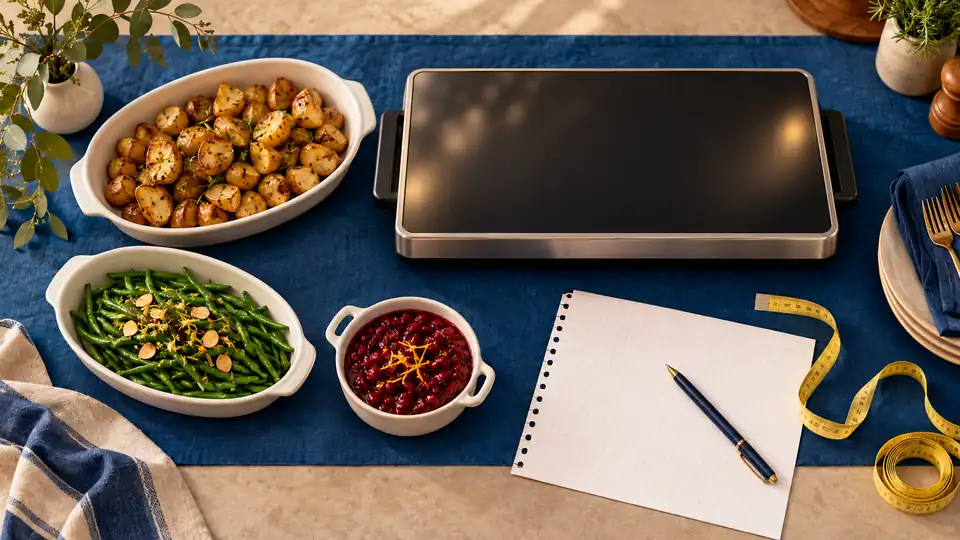
Choose a warming tray by the usable heated surface and the footprints of the dishes that will sit on it, not by guest count alone. Measure each serving container, arrange the dishes in a trial layout, and allow the clearances and cookware types required by the tray’s instructions.
When one surface needs to support several dishes, compare large warming trays against that measured arrangement. Outside dimensions and an advertised number of serving plates do not tell you how your own cookware will fit.
Measure the Part of the Dish That Contacts the Tray
The bottom of a serving dish can be smaller than its rim, handles, or decorative outer edge. Record the base footprint as well as the complete outside dimensions. The base matters for contact with the heated surface; the rest matters for spacing and handling.
For an oval dish, use a bounding rectangle when planning the layout, then check the actual fit. Two tapered bowls may appear to nest together on paper while their handles or lids still collide.
| Measurement | What it helps you decide |
|---|---|
| Dish base length and width | Whether the contact area can sit on the permitted heated surface. |
| Complete dish footprint | Whether rims and handles leave enough room for adjacent containers. |
| Height and lid movement | Whether guests can serve without hitting a shelf, wall, or another lid. |
| Loaded weight | Whether the tray’s support and rated use suit the combined dishes. |
Plan the Usable Surface Rather Than the Outer Frame
Controls, handles, borders, and unheated edges may be included in the appliance’s overall measurements. Check the manufacturer’s description of the usable surface and any restrictions near the edges.
As a layout example, two rectangular dish bases measuring 10 by 7 inches require at least 20 by 7 inches when placed side by side, before allowing for spacing, rims, handles, or the tray’s instructions. This is a geometric illustration, not a recommendation to place dishes edge to edge on a particular model.
Make a paper or tape outline on a cool table and place the empty dishes in their proposed positions. It is easier to discover a lid collision during a dry run than with a hot buffet already assembled.
Keep Dish Depth and Cookware Compatibility in the Decision
A large surface does not automatically make a tray suitable for a deep pot. The food depth, container base, and equipment’s intended use affect how heat reaches the food. Check the permitted cookware and load rather than assuming any heatproof vessel will work well.
Compare warming trays by serving-surface design alongside size. Read the exact instructions for glass, metal, ceramic, and other materials instead of borrowing the compatibility rules from a different model.
Compare One Large Surface With Separate Sections
One larger tray can simplify the physical arrangement, but it may be harder to store or place on a smaller table. Modular formats can offer different layouts, subject to their permitted connections and control arrangement.
Do not assume separate panels mean separate temperature controls. Check which controls affect which areas, how the sections connect, and whether the intended configuration is permitted.
For a serving-line layout, compare warming trays for buffets by the dish arrangement, shared controls, and access around the table. Choose the format that supports the menu rather than the longest tray available.
Leave Space for People, Lids, and Cords
The warmer needs more than a rectangle of counter space. Leave a permitted area for the cord, a stable place for serving utensils, and enough room to remove a hot dish without reaching over another one.
Consider the direction from which guests approach. Handles that are easy for the host to grasp can still obstruct the serving side. Keep the appliance stable and route cords according to its instructions, away from traffic and water.
Distinguish Size From Surface Type
A rigid tray and a flexible mat can occupy a similar area but create different support and storage arrangements. A flexible surface does not eliminate the need for suitable support underneath the cookware.
The comparison of warming trays and warming mats explains that choice. Use it to decide which surface type belongs in the layout before selecting a length.
Check Storage and Cleanup Before Ordering
Measure the cupboard or shelf where the cooled appliance will be stored. Account for fixed handles and cord storage, and follow any restrictions on folding or stacking.
Review the steps for cleaning an electric warming tray as part of the decision. A large serving surface is more convenient when you also have an appropriate place to cool and clean it after the meal.
Keep the final choice tied to the dishes, the table, and the permitted operating method. Those measurements provide a more useful starting point than a generic recommendation based on the number of guests.

- Graham
Keeping food warm isn't always as simple as it sounds. From family dinners to large catered events, different settings call for different equipment. Graham Ellis approaches these choices with an eye for the details that matter, including temperature control, serving capacity, ease of cleaning, and overall convenience. His contributions to Best Food Warmers aim to make the buying process less confusing and help readers find solutions that fit the way they serve food.
- Best Soup Warmers: 9 Picks in 2027 October 19, 2026
- Best Infrared Food Warmers: 9 Picks in 2026 October 18, 2026
- Heat Lamp vs. Heat Strip: Which Is Better for Food Warming? October 17, 2026
- Best Heat Lamps for Food: 9 Picks in 2026 October 16, 2026
- Best Commercial Heated Holding Carts: 9 Picks in 2026 October 15, 2026