How to Hold Nacho Cheese and Bottled Sauces for Service

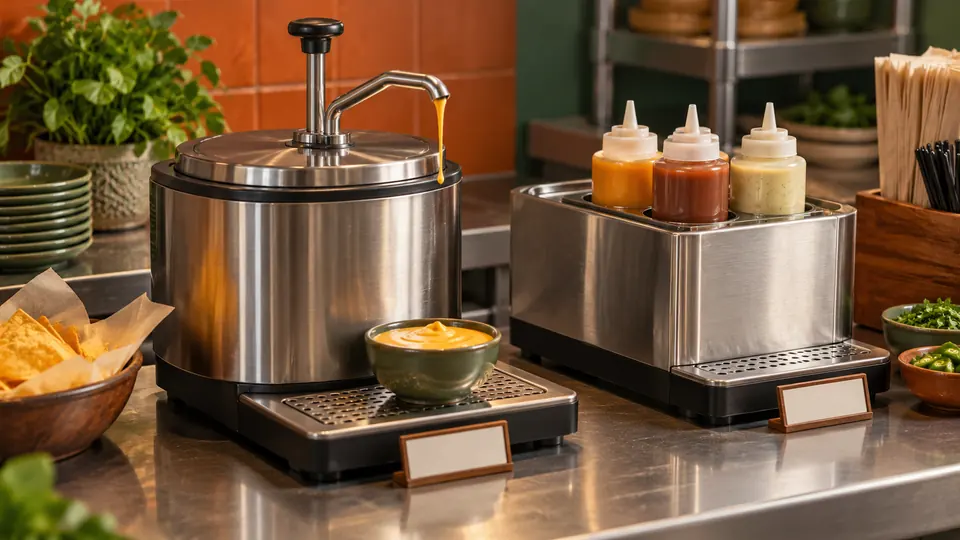
Hold nacho cheese and bottled sauces by matching the equipment to the recipe, container, and dispensing method. Heat the food appropriately before placing it in equipment intended only for holding, monitor the actual sauce, and plan refills and cleaning before service begins. Bulk cheese and small squeeze bottles do not require identical setups.
For a bulk cheese station, compare nacho cheese warmers by dispensing format after deciding whether staff will ladle, pump, or use another approved arrangement. The dispensing method affects access and cleanup as much as the reservoir size.
Separate Bulk Cheese From Bottled Sauces
| Service format | Main planning question | What to verify |
|---|---|---|
| Open pot or inset | Can staff portion sauce without disrupting the holding setup? | Lid access, compatible utensils, usable fill level, and intended heating method. |
| Pump dispenser | Can the sauce move through the approved pump and be cleaned afterward? | Food compatibility, pump assembly, refill procedure, and removable food-contact parts. |
| Squeeze-bottle station | Do the intended bottles fit and work with the heating arrangement? | Bottle material, dimensions, cap configuration, water requirements, and controls. |
These are different workflows rather than interchangeable containers. A bottle that physically fits in a warming well still needs to be approved for that use.
Check the Sauce and the Complete Container
Read the food supplier’s storage and preparation instructions alongside the equipment manual. Recipes differ in ingredients, thickness, texture, and handling needs. Do not assume a setting used for one cheese sauce suits every sauce on the menu.
For pump service, confirm that the product is suitable for the specified pump and assembly. Large pieces or a texture outside the pump’s intended use can create a different dispensing problem from simply choosing a bigger warmer.
For bottles, follow the requirements for material, fill level, lid or cap position, and handling while hot. Do not put a tightly closed container into a heating arrangement unless its instructions explicitly allow it.
Choose Bottled-Sauce Equipment by Its Actual Layout
Count the bottles needed simultaneously and check their outside dimensions. Decide whether each sauce needs separate control or whether the equipment uses a shared setting.
Compare sauce bottle warmers by those details rather than bottle count alone. A three-bottle layout may still be inconvenient if the supplied containers do not suit the menu or staff cannot remove them comfortably.
Check whether the unit heats through a water bath or another arrangement. Add water only where directed, keep electrical components clear of spills, and allow access for the required filling and draining routine.
Do the Heating Step Before the Holding Step
Confirm the intended function of the exact unit. A holding warmer is not automatically a rethermalizer. A high dial setting does not establish that a cold batch will reach the required condition throughout the food.
Use appropriate preparation or reheating equipment where needed, then transfer the sauce using the specified method. Commercial food service should follow the handling requirements and operating procedures that apply to the food.
The guide to setting a warmer and checking food temperature explains why the controller and the sauce need separate checks. Measure the food rather than relying on the temperature of a bottle wall or water bath.
Plan Refills Without Mixing Untracked Batches
Define how new sauce reaches the station, where the reserve batch waits, and who handles the refill. Follow the equipment and food-handling procedure instead of continuously topping up an older batch without tracking it.
Keep tools used for refilling clean and appropriate to the food. Avoid storing a used utensil where it can drip into another sauce or onto an electrical component.
For a bottle station, label the food and any information required by the operation outside the food-contact area. Make identification easy enough that staff do not need to open each bottle to tell sauces apart.
Make Cleanup Part of Equipment Selection
Check whether the lid, pump, nozzle, bottle, and inset can be removed as directed and how each part is washed. A pump’s outside appearance does not show whether the internal food-contact surfaces are accessible.
The guide to cleaning and maintaining commercial warmers provides a framework for that daily routine. Follow the model’s instructions for electrical parts and the applicable cleaning and sanitizing procedure for food-contact components.
For Gravy at a Home Meal
A dinner-table gravy vessel is a different setting from a concession pump station. Start with a small serving portion, an appropriate heating and holding method, and a refill plan. The party guide’s section on serving gravy and other hot dishes at home places that task in the context of a family meal rather than commercial dispensing equipment.
Choose the station around the sauce and the way it is served. A reliable holding routine depends on preparation, containers, access, checks, and cleanup working together.

- Graham
Keeping food warm isn't always as simple as it sounds. From family dinners to large catered events, different settings call for different equipment. Graham Ellis approaches these choices with an eye for the details that matter, including temperature control, serving capacity, ease of cleaning, and overall convenience. His contributions to Best Food Warmers aim to make the buying process less confusing and help readers find solutions that fit the way they serve food.
- How Do Food Warmers Work? November 7, 2026
- How Long Can You Keep Food in a Warmer? November 6, 2026
- Can You Reheat Food in a Food Warmer? November 5, 2026
- What Temperature Should a Food Warmer Be Set At? November 4, 2026
- Best Pizza Warmers: 9 Picks in 2026 November 3, 2026