How Do Electric Lunch Boxes Work?

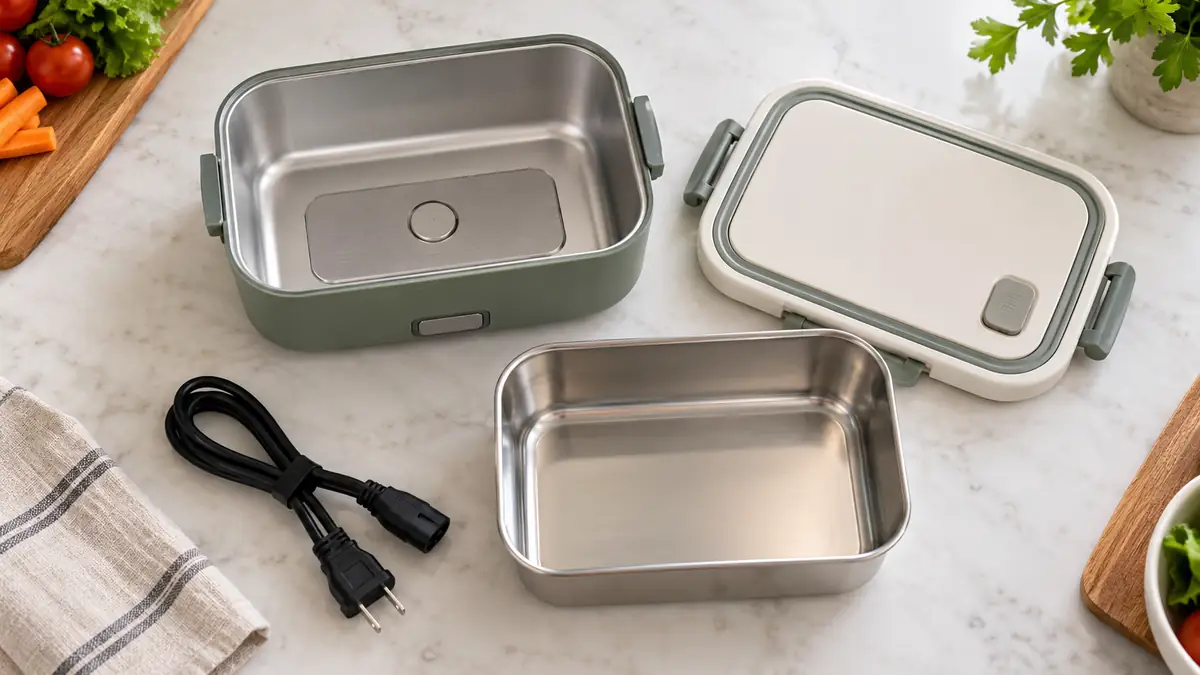
An electric lunch box uses a powered heating element to warm food in a container. Heat moves from the element through a metal plate or food tray and into the meal. Some models also use water to produce steam. Unlike an insulated food jar, which slows heat loss, an electric lunch box actively adds heat while it has a suitable power supply.
The basic idea is simple, but the result depends on the lunch box’s design, its power source, the amount of food, and the food’s starting temperature. Warming an already-hot meal, heating a room-temperature meal, and reheating refrigerated leftovers are different tasks. A model that can do one well is not automatically suitable for all three.
For a model comparison alongside the operating principles, see electric lunch boxes by heating and power design. Match the complete appliance to the food container and the power available during your day.
How Heat Reaches the Food
Most electric lunch boxes have a heating assembly in the base and a removable container that holds the food. Once the appliance is connected to its specified power source and switched on, electrical energy heats the element. Heat then passes into the container and its contents.
Depending on the design, the food may be heated in one or more ways:
- Contact heating: A heated base transfers heat through the bottom of a compatible food tray. Food near the bottom generally warms before food farther away.
- Steam heating: In models with a dedicated water reservoir, the heater warms the water, and steam helps transfer heat around the food container. Add water only if the instructions call for it, and use the specified location and amount.
- Heat retention: A lid and outer housing reduce heat loss while the appliance runs. They do not replace the active heater or guarantee that the food has reached a particular temperature.
Some lunch boxes include a thermostat, timer, or automatic shutoff. Others have a simpler on/off arrangement. These features control or limit appliance operation; they do not directly measure the temperature at the center of a serving of food unless the model specifically includes that capability.
The outer enclosure can also be a soft carrying case rather than a rigid lunch box. When comparing heated lunch bag formats, check which part supplies heat and which part only insulates or carries the food; the shape of the bag does not establish its power source.
What Determines How Quickly a Meal Warms?
There is no reliable heating time that applies to every electric lunch box. A small portion of food that starts warm presents a different task from a full container of cold, dense leftovers. Heating can also be uneven, particularly in deep portions or foods that are difficult to stir.
The main variables are the appliance’s design and rated power, the available power supply, container size and material, food quantity, starting temperature, and how readily heat moves through the food. Rice, a thick casserole, and a thin soup may warm differently in the same unit. Opening the lid repeatedly can also let heat escape.
Higher wattage can indicate greater electrical power use, but wattage alone does not establish how fast the center of a particular meal will heat. Manufacturer time estimates, where provided, should be treated as estimates for the conditions they describe rather than a food-safety guarantee.
Power Sources Are Model-Specific
Some electric lunch boxes plug into a household AC outlet. Others are made for a vehicle’s 12V DC or 24V DC supply, and certain models include more than one compatible cord. Use only a power source and cord specified for the exact appliance. A 12V connection does not establish 24V compatibility, and a household AC cord does not make a lunch box suitable for a vehicle outlet.
Portability does not necessarily mean battery operation. A lunch box with a handle may still need to remain plugged in throughout heating. Likewise, a charging port on a battery-equipped model does not establish that it can heat directly from every USB-C source. Check the appliance’s instructions for its heating and charging requirements.
Plug-In or Battery: Which Fits Your Day?
Choose the power arrangement around the usable outlet and the heating window. A plug-in appliance needs the specified supply while operating. A battery-equipped appliance needs a charging routine and a documented way to heat the intended meal away from that outlet.
| Arrangement | Check before choosing |
|---|---|
| Plug-in heating | The supplied connection, compatible power source, permitted location, and when the outlet is available. |
| Battery heating | Charging method, intended heating function, meal capacity, and the operating guidance for that exact model. |
If there will be no suitable outlet at mealtime, compare cordless heated lunch boxes with the charging and meal schedule together. A charging port is not evidence that every USB supply can power the heater.
The term self-heating can describe different arrangements. Some use electrical power, while other products use a different documented system. Our comparison of self-heating lunch box formats helps separate those designs; check the function of the individual model rather than assuming the label means battery operation.
Using an Electric Lunch Box
The exact procedure varies, especially between contact-heating and steam-heating models. For a typical unit, the general sequence is:
- Check the manual for the permitted food container, fill level, power source, and any water requirements.
- Place food in the approved container and fit the lid or vent as directed. Do not heat food in a tightly sealed container unless the manufacturer explicitly permits it.
- Set the lunch box on a stable surface where its cord and any hot surfaces will not create a hazard. Connect it to the specified power source and start heating according to the instructions.
- If the instructions permit, stir the food during heating to help distribute heat. Use care when opening the lid, since the container and escaping steam may be hot.
- Check the food itself before eating. For a perishable meal that needs thorough reheating, use a food thermometer rather than relying on a timer or the warmth of the container.
- Disconnect the appliance after use. Let it cool before cleaning the removable parts and heating base according to the manufacturer’s directions.
Do not immerse the electrical base unless the manufacturer expressly says it is safe to do so. A removable tray is not necessarily dishwasher-safe or microwave-safe.
Warming Is Not the Same as Safe Reheating
Electric lunch boxes are often described as food warmers, but a warm container does not prove that refrigerated food has been reheated thoroughly. The heating surface can be much hotter than the center of a thick meal. Some models may be capable of reheating leftovers, while others are better suited to maintaining or gradually warming food. Check the stated intended use of the exact model.
For household leftovers, USDA guidance generally recommends reheating to an internal temperature of 165°F (74°C). If an electric lunch box cannot bring the food to the appropriate temperature, use a suitable reheating method instead. Do not treat prolonged gradual warming as a substitute for thorough reheating. Keep perishable food properly refrigerated or otherwise safely cold before heating rather than leaving it in an unpowered lunch box for an extended period.
Hot holding is a separate task. USDA household guidance generally recommends keeping hot food at 140°F (60°C) or above. An appliance setting or a hot-feeling tray does not establish that the food meets that recommendation. Check the food temperature when it matters, and do not assume that a timer’s duration represents a safe holding period.
In short, an electric lunch box converts electrical power into heat and transfers that heat to a meal by contact, steam, or both. Its usefulness for a particular meal depends on its design and power supply. Its safe use depends on following the model’s instructions and checking food temperature rather than judging by the container alone.

- Graham
Keeping food warm isn't always as simple as it sounds. From family dinners to large catered events, different settings call for different equipment. Graham Ellis approaches these choices with an eye for the details that matter, including temperature control, serving capacity, ease of cleaning, and overall convenience. His contributions to Best Food Warmers aim to make the buying process less confusing and help readers find solutions that fit the way they serve food.
- Best Soup Warmers: 9 Picks in 2027 October 19, 2026
- Best Infrared Food Warmers: 9 Picks in 2026 October 18, 2026
- Heat Lamp vs. Heat Strip: Which Is Better for Food Warming? October 17, 2026
- Best Heat Lamps for Food: 9 Picks in 2026 October 16, 2026
- Best Commercial Heated Holding Carts: 9 Picks in 2026 October 15, 2026