Warming Tray vs. Warming Mat: What’s the Difference?

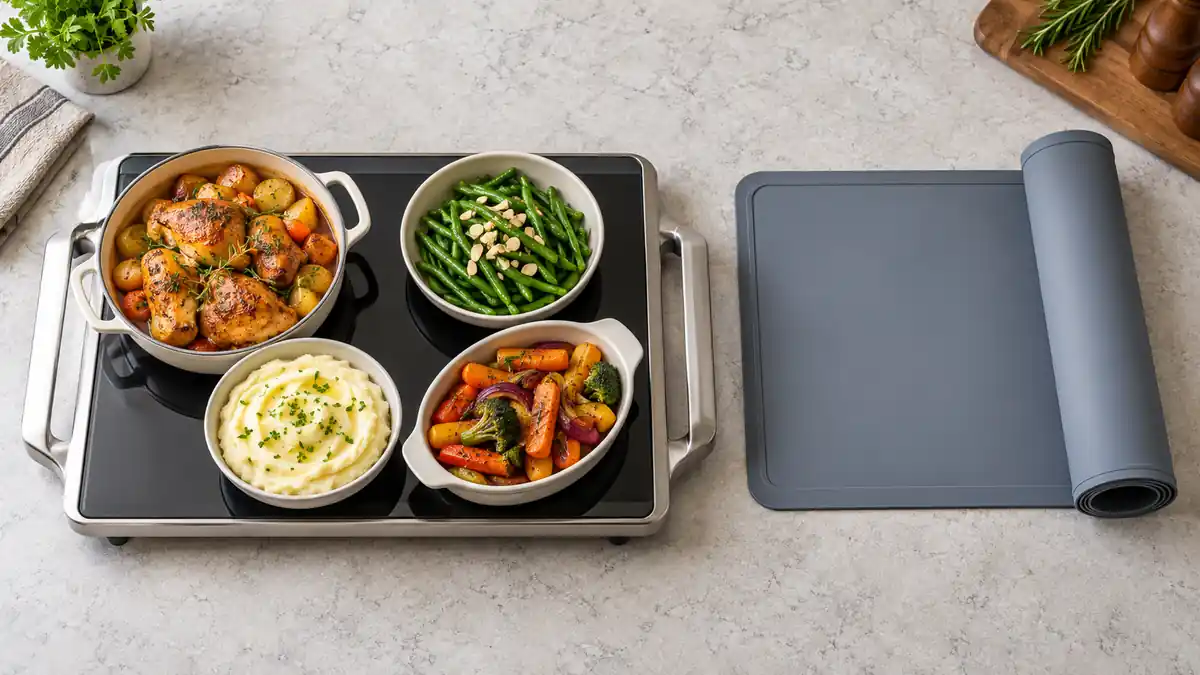
A warming tray is a rigid, heated platform that supports serving dishes. A food warming mat is a flexible, typically silicone-covered heated surface that lies flat during use and may roll up for storage. Both add heat beneath containers of prepared food, but they differ most in how they are handled, stored, and placed on a countertop. Neither type should be assumed to cook food or safely reheat refrigerated leftovers.
If you prefer a firm platform for your serving dishes, our comparison of warming trays for serving dishes helps you weigh size, controls, and storage.
Warming Tray vs. Warming Mat at a Glance
| Feature | Warming Tray | Food Warming Mat |
|---|---|---|
| Construction | Rigid heating surface, often housed in a metal or glass-topped unit | Flexible heating surface, commonly covered in silicone |
| Storage | Stored flat as a rigid appliance | Some models can be rolled or folded after cooling, if their instructions permit |
| Placement | Stands on its feet or base, according to its design | Needs a suitable flat surface beneath the mat |
| Typical use | Holding serving dishes on a defined platform | Holding compatible dishes across a flexible surface |
| Cleaning | Heating surface is generally wiped clean according to the manual | Surface is generally wiped clean according to the manual; electrical parts must be protected |
These are category-level differences, not guarantees about every model. A product sold as a “warming tray” may have a silicone surface, and a mat may have a controller or housing that prevents compact storage. Its construction and operating instructions tell you more than its name.
How Their Designs Affect Everyday Use
A Tray Provides a Rigid Platform
A warming tray has a fixed shape and a firm surface for supported dishes. That can be convenient when serving from several containers in one designated area. Its feet or base position the heated surface as the manufacturer intended. Check the usable heating-area dimensions rather than assuming a dish can safely extend across the entire exterior of the appliance.
Because a tray stays rigid, it usually needs shelf or cabinet space large enough for its full footprint. Some models have adjustable heat settings, while others use simpler controls. The presence of a temperature dial does not tell you how hot food inside a serving dish will become.
A Mat Trades Rigidity for Flexible Storage
A food warming mat rests on the countertop or another manufacturer-approved surface. Its flexibility can make storage easier, particularly if the instructions allow it to be rolled. Let the mat cool first, and follow the specified rolling or folding method. Bending it more tightly than permitted could damage its heating components.
Mat designs vary in size, control placement, and where heat is applied. Keep the controller and cord positioned as instructed, away from spills and serving traffic. A flexible mat still needs a stable, suitable surface underneath it; silicone construction alone does not establish compatibility with every countertop finish.
For a setup that packs away between gatherings, compare flexible food warming mats by usable surface area and storage design.
Which Containers Can Go on the Heating Surface?
For either appliance, use cookware and serving dishes permitted by the specific manufacturer. Material, base shape, size, and how a container sits on the heated area can all matter. A dish that is oven-safe or microwave-safe is not automatically approved for direct contact with a warming tray or mat.
Check these points before setting up a buffet:
- Container material: Confirm that the instructions allow the glass, ceramic, metal, or other material you plan to use.
- Base and footprint: Make sure each dish sits securely within the supported heating area.
- Surface underneath: Follow the appliance’s clearance and countertop-protection requirements. Do not assume a tablecloth, cutting board, or heat-sensitive finish is suitable beneath it.
- Cord location: Route the cord so guests cannot pull on it or trip over it, and keep it clear of hot containers.
A tray’s firm platform can make dish placement more straightforward. A mat may fit into storage more easily, but it should still lie flat and be used without creases unless its instructions say otherwise.
Neither Appliance Replaces Proper Reheating
Warming trays and mats are generally used to help maintain the temperature of food that is already hot. Heat has to pass through the serving dish and into the food, so a warm appliance surface does not prove that the center of a casserole or pot of soup is hot enough. Food depth, dish material, starting temperature, and lid use can affect the result.
Reheat refrigerated leftovers using an appropriate cooking or reheating method before transferring them to a warming surface. For household leftovers, USDA guidance generally calls for reheating to an internal temperature of 165°F (74°C). For household hot holding, USDA guidance recommends keeping hot food at 140°F (60°C) or above. Use a food thermometer to check the food itself rather than relying on a warmer setting.
Commercial food service has separate requirements. The FDA Food Code generally specifies hot holding at 135°F (57°C) or above for foods requiring time and temperature control for safety, subject to applicable exceptions. It is a model code, so a commercial operation must follow its applicable state and local rules. Neither a warming tray nor a mat should be treated as suitable commercial hot-holding equipment without verifying its intended use and performance.
Cleaning and Storage Differences
Unplug either appliance and allow it to cool before cleaning. Follow its manual for the approved cleaning method, including any restrictions around the cord connection, controls, and heating surface. Wipe away spills promptly once it is safe to do so, since dried food can be harder to remove.
Do not submerge an electrical assembly or put a mat in the dishwasher simply because its exterior is silicone. Likewise, a tray with a glass or metal surface is not automatically suitable for abrasive scrubbing. Removable accessories may have different cleaning instructions from the heated base.
Once dry, a rigid tray can be stored in a space that accommodates its shape. Store a mat flat or roll it only as its manufacturer permits. Avoid placing heavy objects on either appliance where they could damage the heating surface, cord, or controls.
Before choosing a rigid tray, see what cleaning an electric warming tray involves after service.
Which Design Fits Your Setup?
A warming tray makes sense when you want a firm, defined platform for serving dishes and have room to store a rigid appliance. A warming mat may suit a setup where compact storage matters, provided the model supports it and you have an appropriate flat surface for use.
For either design, confirm container compatibility, placement requirements, and cleaning instructions before use. The practical difference is the appliance’s construction and handling, not a promise that one type will keep food safer or hotter than the other. Safe hot holding depends on the temperature of the food, which should be checked with a thermometer.

- Graham
Keeping food warm isn't always as simple as it sounds. From family dinners to large catered events, different settings call for different equipment. Graham Ellis approaches these choices with an eye for the details that matter, including temperature control, serving capacity, ease of cleaning, and overall convenience. His contributions to Best Food Warmers aim to make the buying process less confusing and help readers find solutions that fit the way they serve food.
- Best Soup Warmers: 9 Picks in 2027 October 19, 2026
- Best Infrared Food Warmers: 9 Picks in 2026 October 18, 2026
- Heat Lamp vs. Heat Strip: Which Is Better for Food Warming? October 17, 2026
- Best Heat Lamps for Food: 9 Picks in 2026 October 16, 2026
- Best Commercial Heated Holding Carts: 9 Picks in 2026 October 15, 2026