Food Thermos Size Guide for School, Work, and Hiking

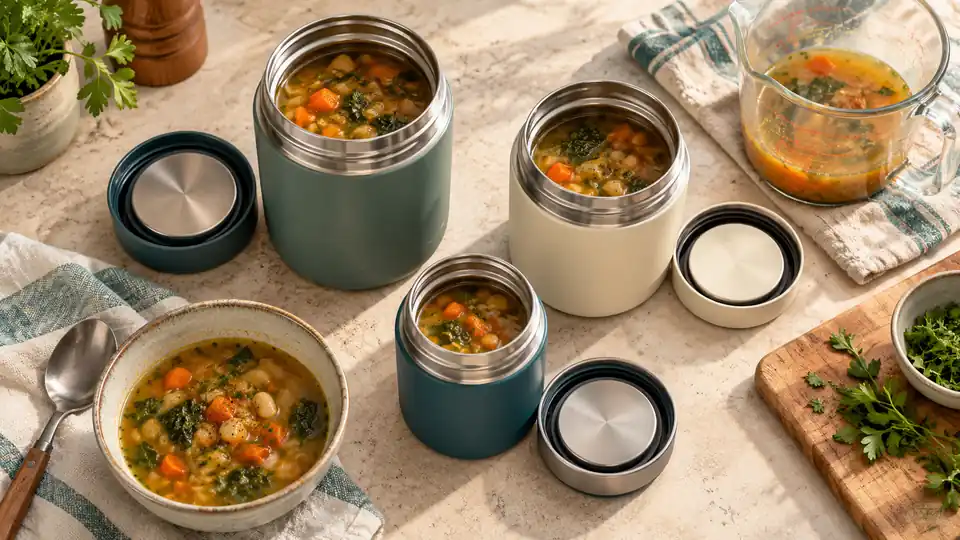
The right food thermos size is the smallest suitable jar that holds the meal you actually eat while leaving the filling space required by its instructions. Measure a normal portion first, then check the jar’s capacity, opening, loaded weight, and fit inside your bag. Age alone is not a reliable sizing rule.
For a work lunch, compare food thermoses for adult portions after measuring your usual meal. A large capacity is useful only if it suits the food and the way you carry it.
Measure a Normal Portion Before Shopping
Put a representative portion of the food you usually pack into a measuring jug or other graduated container. Check the volume of the complete meal, including broth or sauce, rather than estimating from the size of the bowl you eat from.
A soup portion and a loosely packed pasta portion can occupy different volumes even when both feel like a satisfying lunch. If your meals vary, measure two or three typical portions and decide which one the jar needs to accommodate.
| Listed fluid capacity | Equivalent US-cup volume | How to use the number |
|---|---|---|
| 10 fl oz | 1¼ cups | Compare with a smaller measured serving, then allow for the specified fill limit. |
| 12 fl oz | 1½ cups | Check whether the complete meal fits, including any liquid. |
| 16 fl oz | 2 cups | Useful as a comparison point for a measured larger serving. |
| 24 fl oz | 3 cups | Check loaded weight and carrying space before choosing the extra volume. |
These are volume conversions, not age recommendations or promises about how much food a particular jar can safely hold. Confirm whether the seller’s “oz” figure describes fluid capacity, and use the marked fill guidance for the exact product.
Distinguish Nominal Capacity From Comfortable Filling
You need room to close the lid without pushing food into the threads or gasket. Follow the manufacturer’s maximum fill level and any instructions for hot contents. Do not choose a jar that requires compressing every lunch against the lid to make it fit.
Buying a much bigger jar just in case also has a cost in bulk and weight. A half-filled large jar creates a different packing arrangement from the conditions behind a manufacturer’s retention claim. Do not assume the larger jar automatically keeps your smaller serving hot for longer.
For School, Check Handling as Well as Portion Size
Have the child practice opening and closing the empty jar at home. Check the grip, lid resistance, and whether the opening is comfortable for the utensil they use. The jar also needs to fit the lunch bag without crowding out the rest of the meal.
Compare food thermoses designed for kids by those handling details alongside capacity. Choose a size around the child’s measured lunch rather than using a manufacturer’s age chart as a strict requirement.
Pack hot contents in line with the product’s instructions and the child’s ability to handle them. A smaller jar does not remove the need for sensible handling of hot food.
For Soup, Measure the Liquid and Check Serving Access
A wide opening makes ladling food in and eating from the jar easier, but it also changes the size of the lid you carry and clean. Check that the spoon can reach the bottom and that the jar can sit stably where lunch will be eaten.
For soup-based meals, compare soup thermoses by capacity and opening after measuring the complete portion. Check whether you want to eat from the jar or pour into a separate bowl; those are different serving routines.
For Hiking, Account for the Packed Load
The useful size is a combination of meal volume, empty-jar weight, loaded weight, and the room left for other equipment. A jar that is comfortable on an office desk may be awkward in a small daypack.
Our comparison of soup thermoses for hiking focuses on that carrying context. Check the jar’s outside dimensions and how it will sit in the pack, not only its listed ounces.
Keep Size and Heat Retention as Separate Decisions
Capacity helps you choose how much to pack. It does not establish a guaranteed number of safe holding hours. Insulation, food temperature at packing, lid design, surroundings, and opening frequency all affect the result.
Use the steps for preheating and packing a food thermos to prepare a suitable jar, then review what changes a thermos's heat retention when planning the time between packing and eating.
A Short Fit Check
- Measure the usual portion in fluid volume.
- Check the exact jar’s usable fill guidance.
- Measure its outside dimensions against the bag.
- Check the loaded weight and lid handling.
- Confirm cleaning access to the opening, threads, and gasket.
Choose the jar that fits that complete routine. There is no need to move up a size if doing so only adds an empty compartment and a heavier lunch bag.

- Graham
Keeping food warm isn't always as simple as it sounds. From family dinners to large catered events, different settings call for different equipment. Graham Ellis approaches these choices with an eye for the details that matter, including temperature control, serving capacity, ease of cleaning, and overall convenience. His contributions to Best Food Warmers aim to make the buying process less confusing and help readers find solutions that fit the way they serve food.
- Best Soup Warmers: 9 Picks in 2027 October 19, 2026
- Best Infrared Food Warmers: 9 Picks in 2026 October 18, 2026
- Heat Lamp vs. Heat Strip: Which Is Better for Food Warming? October 17, 2026
- Best Heat Lamps for Food: 9 Picks in 2026 October 16, 2026
- Best Commercial Heated Holding Carts: 9 Picks in 2026 October 15, 2026