Holding Cabinet vs Warming Drawer vs Heated Cart

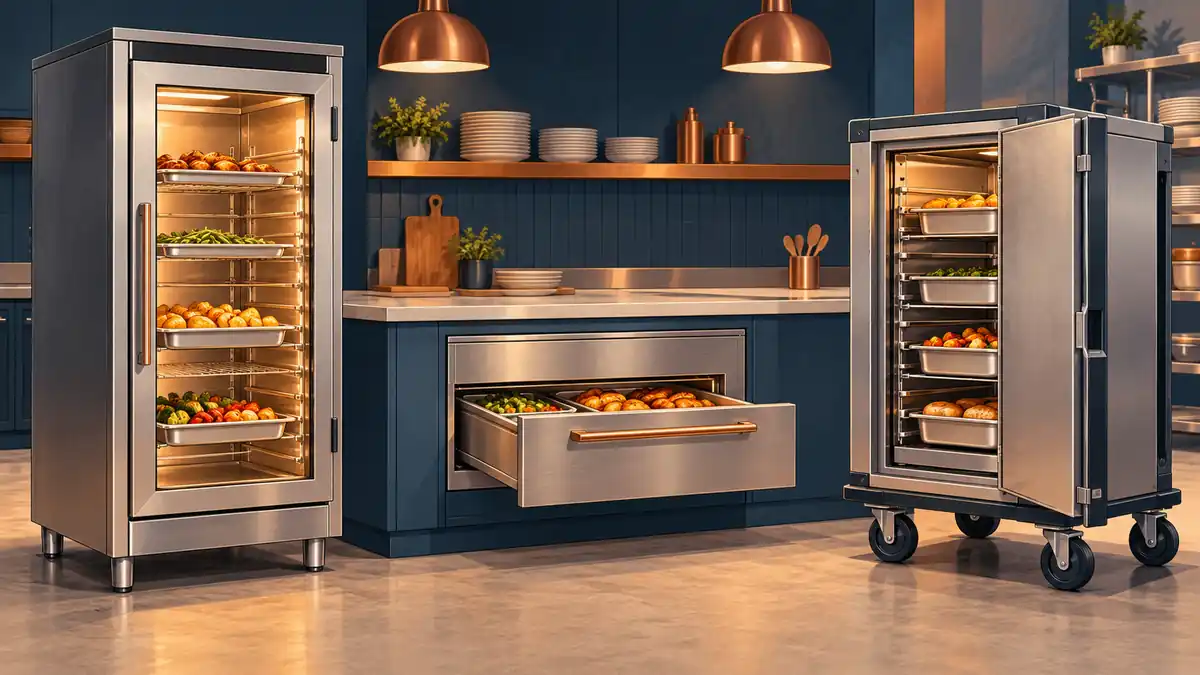
A holding cabinet suits enclosed storage for prepared pans before service. A warming drawer keeps a smaller working supply within reach of a station. A heated cart adds a mobile format for moving food between locations, although wheels do not mean the heater continues operating without power. Choose by how food moves through the kitchen.
If prepared pans will wait in an enclosed unit, compare commercial hot holding cabinets by usable space, access, and the containers you need to load. Start with the working capacity rather than the outside dimensions.
Compare the Three Formats by Their Job
| Format | Typical role | Main question |
|---|---|---|
| Holding cabinet | Keep a supply of prepared pans or trays ready before service. | Can staff load and remove the required containers without disrupting the station? |
| Warming drawer | Keep food accessible near a finishing or assembly point. | Does the drawer’s pan arrangement fit the small batches used at that station? |
| Heated cart | Move an organized load and provide powered holding where connected. | What happens to the load and its temperature during the unplugged part of the journey? |
These categories overlap. A cabinet can have casters, a drawer can be built into a counter, and a cart may use a cabinet-shaped enclosure. Read the complete configuration instead of treating the product name as a separate heating technology.
Choose a Cabinet for the Backup-Pan Stage
A cabinet is useful when several pans need to wait away from the active serving line. List the pan and tray sizes, the number held simultaneously, and any clearance needed above the food. Shelf count alone does not establish how many loaded pans fit.
Consider whether staff will load it once before service or open it frequently for individual pans. Door swing, viewing windows, shelf spacing, and control access affect that routine. Check the exact equipment’s requirements for ventilation and placement.
The broader comparison of food warming cabinet configurations can help when you are weighing countertop and larger enclosure formats. Verify each model’s intended use and compatible containers before choosing by its stated tier count.
For the underlying definition and operating role, see what a hot holding cabinet does. It explains why a holding enclosure should not automatically be treated as cooking or reheating equipment.
Choose a Drawer for Food Needed Within Reach
A warming drawer fits a workflow where a station needs repeated access to a working batch. It can reduce the distance between holding and assembly when its location and container arrangement suit the task.
Compare commercial warming drawers by internal pan layout, opening clearance, and installation format. Check that the drawer can open fully without blocking an aisle or colliding with another appliance.
Do not assume every drawer has independent controls, humidity adjustment, or the same pan depth. Some units are intended to be built in; others have different placement requirements. A unit that looks compact may still need significant space in front of it when fully extended.
Choose a Heated Cart When Movement Is Part of Service
A mobile format can be useful between preparation and a remote serving area. Plan the entire route: doorways, thresholds, ramps, floor changes, turns, and the space available to park the loaded cart. Check the loaded weight as well as the empty equipment weight.
For that task, compare commercial heated holding carts by pan support, wheel arrangement, insulation, and the documented power requirements. Fit the equipment to the route rather than choosing a cart solely because it has the most shelves.
Powered heating and passive heat retention are different. Many heated carts need an electrical supply to add heat. During an unplugged move, insulation may slow cooling, but the heater’s presence does not establish an off-power holding duration.
Check the manufacturer’s transport instructions and the operation’s temperature-monitoring procedure. Do not run an extension lead along a travel route as a substitute for a suitable transport arrangement.
Compare Usable Capacity and Access Together
Write a simple load list before deciding on size. For example, record which pans contain backup food, which need immediate access, and which must be removed without disturbing another loaded shelf. This is a workflow exercise, not a universal pan-count formula.
A tall cabinet can provide storage while still being inconvenient for a short worker reaching a heavy upper pan. A drawer can offer convenient access while holding fewer simultaneous menu items. A cart can move a large load but require more maneuvering space than the kitchen has.
Check the Holding Environment for the Actual Food
Some equipment offers vents, water reservoirs, humidity controls, or other ways to manage the enclosure. Other designs use a different approach. Do not assume water or added humidity is a universal requirement for enclosed holding.
Food quality matters alongside temperature. Covered sauces, crisp foods, baked goods, and plated meals do not all benefit from the same moisture conditions. Match the documented intended application to the menu and check the food rather than relying on the air-temperature display.
Include Installation and Cleanup in the Decision
Confirm the exact unit’s electrical and installation requirements. For built-in equipment, check the cabinet opening, clearances, and service access before ordering. For mobile equipment, check parking space and the handling instructions for moving it.
Walk through removing shelves, rails, pans, and any water components. The guide to cleaning and maintaining commercial warmers helps organize the upkeep questions to ask before installing an enclosure that staff cannot conveniently clean.
Which Format Should You Start With?
- Choose a cabinet when the main need is an enclosed reserve of prepared pans.
- Choose a drawer when the main need is a smaller working supply at a specific station.
- Choose a heated cart when a loaded holding unit must move as part of the operation.
A kitchen may use more than one format because storage, station access, and transport are separate jobs. Define the job first, then compare the configurations that fit it.

- Graham
Keeping food warm isn't always as simple as it sounds. From family dinners to large catered events, different settings call for different equipment. Graham Ellis approaches these choices with an eye for the details that matter, including temperature control, serving capacity, ease of cleaning, and overall convenience. His contributions to Best Food Warmers aim to make the buying process less confusing and help readers find solutions that fit the way they serve food.
- Best Soup Warmers: 9 Picks in 2027 October 19, 2026
- Best Infrared Food Warmers: 9 Picks in 2026 October 18, 2026
- Heat Lamp vs. Heat Strip: Which Is Better for Food Warming? October 17, 2026
- Best Heat Lamps for Food: 9 Picks in 2026 October 16, 2026
- Best Commercial Heated Holding Carts: 9 Picks in 2026 October 15, 2026