How to Choose a Commercial Food Warmer

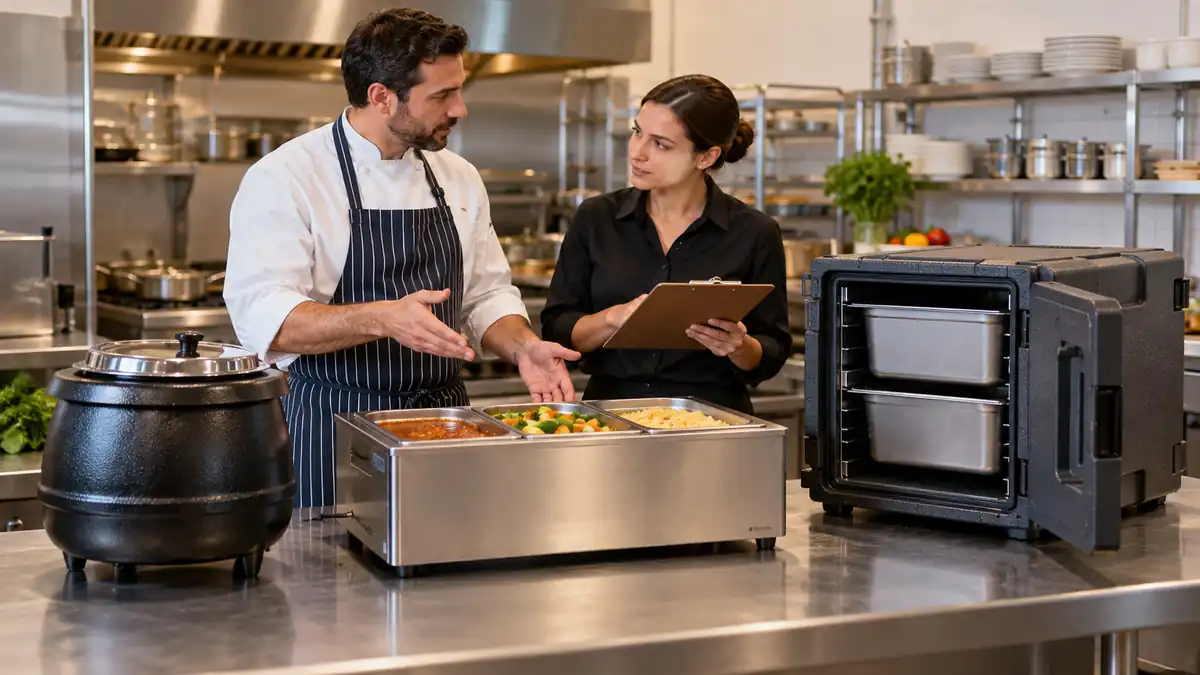
Choose a commercial food warmer by starting with the food and the point in service where it needs to stay hot. A steam table can serve food directly from pans, while a holding cabinet keeps prepared pans ready away from the serving line. From there, check usable capacity, the food’s holding needs, the available power and water connections, cleaning requirements, and the rules that apply to your operation. The right equipment must maintain safe food temperatures under your actual serving conditions, not merely display a suitable thermostat setting.
Once you have defined the serving task, compare commercial food warmers by equipment type to narrow the available configurations.
Match the Warmer to the Job
Write down what will be held, where staff or customers will access it, and how food will move through the kitchen. A unit that fits a serving line may be awkward for back-of-house storage. Equipment that keeps covered pans hot during transport may offer no way to add heat once loaded.
| Equipment type | Typical role | Key question to ask |
|---|---|---|
| Steam table or heated food well | Holding food in pans at a staffed or self-service line | Does it accommodate the pans and serving arrangement you use? |
| Countertop food warmer | Holding a smaller quantity near a prep or service station | Is there enough usable capacity without crowding the workspace? |
| Hot-holding cabinet | Storing prepared pans or trays before service | Will the shelving, door access, and internal space suit your containers? |
| Heat lamp or strip heater | Providing radiant heat at a pass or pickup area | Does its approved installation provide suitable coverage for the food below? |
| Chafing dish | Presenting food at a buffet or temporary serving station | Can the permitted heat source and setup meet the venue’s operating requirements? |
| Insulated carrier | Reducing heat loss during transport | How will food temperature be monitored without active heating? |
Equipment names can overlap. A bain-marie may describe a water-bath warming arrangement, including a countertop unit or part of a serving line. Check the specific unit’s construction and instructions rather than relying on its category name. Some heated wells require water; others operate differently. A holding cabinet may or may not offer humidity control.
Decide What the Equipment Must Do to the Food
Most commercial food warmers are intended for hot holding: maintaining food that has already been cooked or reheated appropriately. Cooking, reheating, and hot holding are separate tasks. Do not assume a warmer can bring refrigerated food up to a required reheating temperature simply because it has an adjustable thermostat.
If the operation needs to reheat food in the same unit, check the exact model’s documentation for that capability and confirm that its process can meet applicable food safety requirements. Otherwise, use appropriate cooking or reheating equipment before transferring food to the warmer. A passive insulated carrier adds no heat; it slows heat loss from food loaded hot.
Check Food Temperature, Not Just the Display
The FDA Food Code generally specifies hot holding at 135°F (57°C) or above for foods requiring time and temperature control for safety, subject to its provisions and exceptions. It is a model code, so the requirements for a commercial operation depend on the rules adopted and enforced in its jurisdiction. Confirm those requirements with the applicable health authority and your food safety procedures.
A cabinet display measures or controls conditions in the cabinet, not necessarily the temperature inside a deep pan of food. The same distinction applies to a steam table’s water bath and a chafing dish’s heat source. Plan to check food with a suitable thermometer at the locations and intervals required by your operation. Consider whether frequent door openings, pan changes, or service from uncovered pans will make temperature maintenance harder.
Size Capacity Around Pans and Service Flow
Start with the containers already used by the kitchen. Record their dimensions, depths, and the number that must be held at once. Then compare those details with the manufacturer’s stated compatible pan sizes and usable layout. A cabinet’s external dimensions do not reveal how many loaded pans fit inside, and a warmer’s nominal capacity may not reflect space needed for lids, shelves, or access.
- At a serving line: Allow room for the dishes offered simultaneously, serving utensils, pan replacement, and staff access.
- In a holding cabinet: Check shelf spacing, pan orientation, door swing, and whether staff can remove a loaded pan safely.
- At a prep station: Measure the available counter footprint, including space for controls, cords, and handling hot containers.
- For transport or events: Account for loaded weight, stable placement, and the route between preparation and service.
Capacity should also reflect the service pattern. Holding a large batch for a long period can affect food quality, while a unit that requires constant pan replacement may disrupt service. Map when pans will be loaded and changed rather than sizing equipment from the menu’s total daily volume alone.
For a prep station with limited space, compare countertop food warmers for smaller stations against your usable pan capacity and counter footprint.
Choose a Heating Method That Suits the Food
The way heat reaches a pan can affect operation and food quality. Water-bath units transfer heat through heated water and require attention to the specified water level, filling procedure, and drainage. Other units heat wells or surfaces more directly. Heated-air cabinets hold pans within an enclosed space; some models provide adjustable humidity, while others do not. Radiant heaters warm exposed food or containers from above, with coverage determined by their installation and design.
Ask how the equipment handles the foods you serve. Covered pans of sauce, plated meals at a pass, and crisp foods awaiting pickup have different exposure to air and moisture. A humidity feature may help with some foods but be unsuitable for others. Review the manufacturer’s intended applications and plan a holding procedure that preserves quality while meeting temperature requirements. Wattage or a high maximum setting alone cannot establish how evenly a particular food will hold.
Our explanation of steam tables and bain-marie water baths clarifies the equipment terms used in these listings.
Verify Installation Requirements Before Selecting a Unit
A warmer that fits physically may still be impractical to install. Check the exact model’s voltage, plug or wiring requirements, rated electrical load, and installation instructions against the intended location. Have a qualified person assess the electrical supply where needed. Do not modify plugs, defeat grounding, or assume an available outlet has enough circuit capacity.
For water-bath equipment, find out how it is filled, monitored, emptied, and cleaned. A built-in drain may be useful only if its location works with the installation. For fuel-heated chafing dishes, confirm that the manufacturer-approved fuel and setup are permitted by the venue and applicable fire-safety rules. Open flames require stable placement and appropriate clearance from combustible materials.
Also check access around the unit. Staff need a safe way to load hot pans, reach controls, open doors or lids, and clean adjacent surfaces. Installation instructions may specify placement restrictions that rule out an otherwise convenient location.
Examine Controls, Cleaning, and Documentation
Useful controls are ones staff can operate consistently. Check how temperatures are set and read, whether a cabinet provides the humidity control your food requires, and how the unit indicates operating status. A timer or thermostat is an equipment feature, not proof that food has stayed at a safe temperature. Keep thermometer checks and any required records in the operating procedure.
Before committing to a configuration, work through a normal cleaning shift. Can staff remove pans and shelves? Are food-contact areas reachable? Does a water-bath unit have a practical way to drain and clean it? Electrical assemblies, removable parts, and food-contact surfaces may have different cleaning instructions. Follow the model’s manual and the cleaning and sanitizing requirements that apply to the operation; never assume a removable component is dishwasher-safe.
Check documentation for the exact model, including its operating manual, compatible accessories, and any required installation conditions. If sanitation or electrical certification is needed for your operation, verify the complete model’s status through appropriate documentation or certification records. A “commercial” label, a certified component, or a claim attached to another model does not establish that this unit meets your requirements.
Use our commercial warmer cleaning and maintenance guide to think through access, removable parts, and the end-of-service routine.
Use a Short Selection Checklist
- Define the station: Identify whether the unit will serve food, hold backup pans, support pickup, or protect food during transport.
- List the food and containers: Note pan dimensions, depths, lids, menu items, and how often staff will load or replace them.
- Confirm the heating function: Determine whether the equipment is for hot holding, and arrange separate cooking or reheating equipment where required.
- Check temperature procedures: Confirm applicable local rules and decide how staff will measure and record food temperatures.
- Verify the site: Match electrical, water, drainage, ventilation, and placement requirements to the intended location.
- Review daily upkeep: Read the exact model’s instructions for cleaning, maintenance, compatible parts, and any required certification.
The strongest choice is the unit that fits the kitchen’s containers and workflow while allowing staff to hold and monitor food properly. Confirm those practical details before treating capacity, controls, or a commercial label as a reason to select any particular warmer.

- Graham
Keeping food warm isn't always as simple as it sounds. From family dinners to large catered events, different settings call for different equipment. Graham Ellis approaches these choices with an eye for the details that matter, including temperature control, serving capacity, ease of cleaning, and overall convenience. His contributions to Best Food Warmers aim to make the buying process less confusing and help readers find solutions that fit the way they serve food.
- Best Soup Warmers: 9 Picks in 2027 October 19, 2026
- Best Infrared Food Warmers: 9 Picks in 2026 October 18, 2026
- Heat Lamp vs. Heat Strip: Which Is Better for Food Warming? October 17, 2026
- Best Heat Lamps for Food: 9 Picks in 2026 October 16, 2026
- Best Commercial Heated Holding Carts: 9 Picks in 2026 October 15, 2026