How to Transport a Hot Casserole to a Potluck

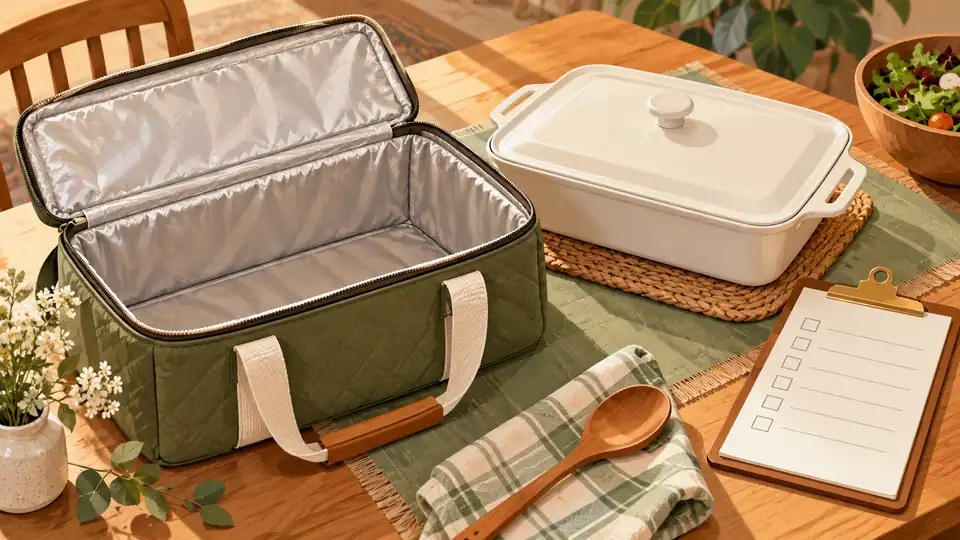
To transport a hot casserole to a potluck, use a covered dish that fits securely inside an insulated carrier, keep it level during the journey, and arrange a holding or serving spot before you leave. The carrier slows cooling during the trip; the equipment waiting at the venue handles the serving stage.
Start with the dish you actually use, including its handles and lid. Once you have those measurements, compare insulated casserole carriers that fit your dish rather than choosing a tote from its advertised pan size alone.
Measure the Dish Before Choosing the Carrier
A “9-by-13-inch” baking dish describes a nominal size, not necessarily its complete outside footprint. Handles, a flared rim, and a domed lid can make the packed dish substantially larger. Measure its outside length, width, and height with the lid fitted, then compare those figures with the carrier’s usable interior.
Check the opening as well as the compartment. A dish may fit the base of a bag yet be awkward to lower through a narrow zipper opening. You should be able to load and remove it without tilting a pan of sauce toward the closure.
| What to check | Why it matters |
|---|---|
| Outside dimensions, including handles | Prevents buying a carrier that fits the pan body but not the complete dish. |
| Height with the lid in place | Leaves room to close the carrier without pressing down on the cover. |
| Loaded weight | Shows whether the dish can be carried comfortably and within the carrier’s rating. |
| Base and access opening | Helps keep the pan level while loading, carrying, and unloading. |
Prepare the Food and the Container Separately
Have the carrier, lid, serving utensils, and transport space ready before the casserole comes out of the oven. That avoids leaving the food on the counter while you look for a bag or clear the car.
Cook the casserole thoroughly before packing. If you are taking previously cooked leftovers, reheat them separately; USDA recommends an internal temperature of 165°F for reheated leftovers. For household hot holding, keep the food at 140°F or above. Measure the food itself, not the outside of the dish.
Follow the carrier’s instructions about hot cookware and any preheating method. A bag intended to carry warm food is not automatically suitable for a dish taken straight from a very hot oven. Do not pour hot water into a soft carrier or add a heating insert unless its manufacturer permits it.
Pack the Casserole So It Stays Level
- Fit a suitable cover. Use the dish’s compatible transport lid or an appropriate cover that keeps food contained. A carrier’s zipper is not a substitute for a secure food-container lid.
- Check the carrying base. Use the support supplied or approved for the carrier. Keep a heavy dish centered rather than resting one handle against a soft side.
- Close the compartment. Route handles and zippers so the bag closes completely. Keep serving utensils outside the food compartment if they prevent a proper closure.
- Secure it for the journey. Choose a stable, level position where the carrier cannot slide, tip, or interfere with driving. Avoid stacking loose items on the lid.
- Leave it closed until unloading. Keep labels or a note of the contents outside the bag so nobody needs to open it just to identify the dish.
For several covered pans or repeated catering trips, the carrying arrangement may matter more than a tote’s appearance. Compare insulated food carriers for multiple pans when you need organized loading and a more structured transport format.
Arrange the Potluck Serving Spot Before You Leave
Ask the host three practical questions: when will the food be served, is a suitable outlet available, and will your dish fit the equipment already on the table? Bringing an electric warmer is useful only if its power connection, footprint, and permitted cookware match the venue.
If you need to bring the serving equipment too, compare food warmers for potluck tables by the dish size and heat source you can actually use. A carrier and a table warmer solve different parts of the trip.
At a larger staffed event, plan where backup pans will wait and who will replace the serving pan. Our comparison of food warmers for catering setups is more relevant to that workflow than choosing equipment solely for one family baking dish.
Check the Casserole on Arrival
Unload onto a stable, heat-resistant surface and check the food temperature. A warm handle, condensation under the lid, or a hot-feeling carrier does not show the temperature in the center of the casserole.
Move the dish promptly into its planned serving or holding position. For the buffet layout and replenishment routine, follow the guide to keeping food warm for a party. Keep the lid on between servings where practical and provide a separate utensil for each dish.
If the food has cooled, the next step depends on its time and temperature history and the reheating facilities available. Do not simply put it on a low-powered serving warmer and assume the problem is solved. The guide to holding time and food temperature explains the distinction.
Common Transport Questions
Can a towel replace an insulated casserole carrier?
A towel may help with handling or slow some heat loss, but it does not provide the same fitted closure, stable base, or carrying arrangement as a suitable carrier. Keep cloth away from heat sources, and do not rely on wrapping alone to establish a safe transport time.
Should I leave the casserole in the carrier during the potluck?
Use the carrier for its intended purpose. Opening a soft transport bag repeatedly for serving can be awkward, and passive insulation adds no heat. Unload into the serving setup you arranged with the host.
What should I pack besides the casserole?
Bring the fitted cover, suitable heat protection for handling the dish, a serving utensil, and a food thermometer. Label the dish and any ingredients guests need to know about before the bag is closed.

- Graham
Keeping food warm isn't always as simple as it sounds. From family dinners to large catered events, different settings call for different equipment. Graham Ellis approaches these choices with an eye for the details that matter, including temperature control, serving capacity, ease of cleaning, and overall convenience. His contributions to Best Food Warmers aim to make the buying process less confusing and help readers find solutions that fit the way they serve food.
- Best Soup Warmers: 9 Picks in 2027 October 19, 2026
- Best Infrared Food Warmers: 9 Picks in 2026 October 18, 2026
- Heat Lamp vs. Heat Strip: Which Is Better for Food Warming? October 17, 2026
- Best Heat Lamps for Food: 9 Picks in 2026 October 16, 2026
- Best Commercial Heated Holding Carts: 9 Picks in 2026 October 15, 2026